2003-2012/2012-2016/2016-2020/2020-2026

Revival (2012-2014)
College, Game Jams, and Sassy Echidna Software
Waker, Empty Chambers, Digital Toilet World, Toilets, Meat, and Drugs, and The Void Hero Blues

Me revisiting Ohio University's Reed Hall in 2019, where I lived when working on Station to Station and Waker
I left for college in 2011, leaving Baltimore for Ohio University (not to be confused with Ohio State) in the Appalachian town of Athens. While I majored in political science, I'd take some electives in computer science the first couple of years to finally get some formal training in programming. Despite having taught myself to code years prior, learning actual best programming practices and the power of "for" loops was very helpful.

Inside my 2011 dorm room, where Station to Station died

Outside my 2011 dorm room??? No wonder nothing got finished!
By July 4th of 2012, I had grown frustrated having gone years without creating a complete game, so to help motivate myself to finish a project, I created my first blog: Sassy Echidna Software! I posted to the blog prolifically both to share progress on games I was working on, write about what I was playing, and share thoughts on games more generally.

My first of very many posts to Sassy Echidna Software! Note the screenshots of unfinished games from 2010-2012. I don't remember what the original site theme was - I reskinned the site to look like Waker's UI after I started working on that game.
I was still struggling to find value in game making – in my earliest posts, I wrote about the types of moments in games "that actually give the medium value" and bemoaned games with the "usual stories of wizards and space marines." By November of that year, I had started exporting my thoughts and reviews on games to my University's online mag culture magazine, Beta Fish, under a series of articles titled "Radical Plaything." I'd write 13 articles for the magazine from November 2012 through December 2013, with my writing pedestaling indie games and the potential of games to tell deeper stories, interrogating the feasibility of notgames, and criticizing in-game violence. (I wrote a glowing review of Anodyne that co-creator Melos Han-Tani managed to find and comment on, which was a nice surprise. I'm glad the Analgesic Productions duo is still going strong 13 years later.).

All of my Beta Fish articles began with this little header image. They were cute.
Around when I started the blog, I had been working on a very short-lived sci-fi narrative adventure called Spacepunk before promptly starting development on my next overscoped narrative adventure quagmire: Waker. Waker began as an entry for the week-long Mini Ludum Dare #36 competition, the first game jam I'd ever attempt. Had everything gone to plan, I'd have made an appropriately scoped game and released it at the end of the week. However, my project file for the game was corrupted on the second day, derailing development and causing me to miss the jam's original deadline. Free of a deadline constraint, I would proceed to work on Waker for 2 more years.

A screenshot from the end of the first day of Waker's development.
Of all of my abandoned narrative adventure games, Waker was the closest to being realized as a "solo indie masterwork." That summer, I was working an internship in a cubicle and was losing my mind, so the game was about an office worker in a monochromatic world who would fall asleep at his desk doing mind-numbing work and find himself in a colorful fantasy world during its apocalypse. But which world was real? There were dialogue trees, exploration, puzzles, action segments, and a branching narrative with multiple planned endings.

Waker's dream world looked like this, 1 month in. The tiles were a little rough at this stage.
2012 was a different time – you still could just throw a game onto the internet, and if it looked good enough and you shared it to the right place, total strangers would care. That couldn't happen today. I posted about the game on TIGsource and got attention for it. I forgot this happened, but Waker was featured as an "awesome new game in development" in Dom2D's Tigsource Devlog Magazine in January of 2013 – it's surreal to see Waker mentioned in the same breath as Crosscode, Momodora III, and motherfuckin' Owlboy. Games writer Paul Hack had covered Waker for his blog, Indie Game Hunt, and seeing my work covered alongside games by Maddie Thorson (best known for Celeste) and Terry Cavanagh got to my head. A sound designer named Ashton Morris had contacted me asking to handle audio for the project, and he had written a couple of really nice songs for it. I submitted a trailer for the game with one of his songs that was to be shown during the stream for IndiE3, a multi-day showcase of indie game trailers in June of 2014. All of this coverage fed into the illusion that I was working on a polished, indie magnum opus, that I was finally one of the big kids.

Waker, as of May 2013. The game shaped up a lot over the first year - at this point, it had cleaner tilework, painstakingly mapped shadows, character animations, branching dialogue, action sequences, an inventory screen.
And maybe that was true, to an extent, but while I was close to fully maturing as a creative, I don't think all of my skills were quuuiiiite there yet. Waker's backgrounds and top-down character art looked great, I'll give myself that, and the story had a few moments of emotional incisiveness. But the weirdly low-res character portraits, I think, were ugly, and while my dialogue was a clear improvement from spiritual predecessor Station to Station, it still needed improvement. I hadn't yet learned how to pace a story. My attempts at social commentary were often sophomoric and awkward.

Waker, February 2013. The game was already low-res, so why did I render the character portraits at half of *that* resolution?
By June of 2013, just a year into development I was already writing about how the project was burning me out. Not only was there a lot of pressure for this game to live up to other people's expectations, it was a depressing, over-serious game, and I needed to inject some levity into it. So, I gave the protagonist a constant, cheery companion – a small, white, floating creature called Sue the Poggle.
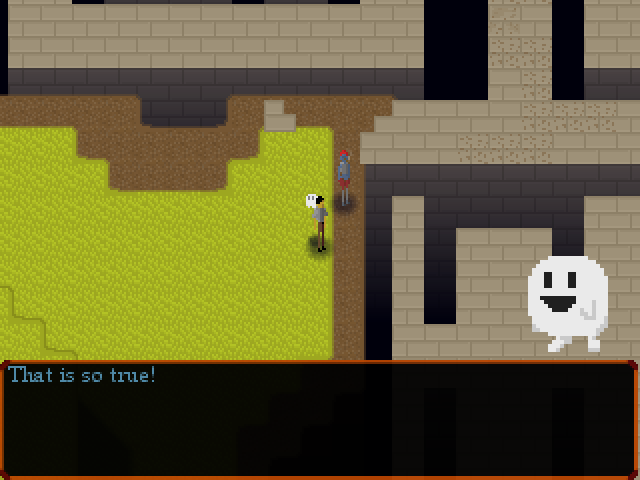
Sue! I honestly like her design more than the DZF Poggle design. Maybe I'll go back to this for future Poggles...
Sue was important for a couple of reasons. It was an important lesson in fiction writing – I finally figured out that if you're gonna tell a dark story, you just gotta have some brightness to make the darkness hit, and vice-versa. By the halfway point in the story, the upbeat Sue gets the narrative short end of the stick, and it stings. But she wouldn't be the last Poggle I put in a game – anyone who's played Danger Zone Friends or Jailbird Nocturne knows that those worlds are populated by (armless, terrestrial, but still cheerful) Poggles. It's nice that not all the creative work I put into Waker was for naught; many of the lessons I had learned and much of the work I had done would be reused to better effect in later games. I don't know if any of my other games would've been so well-written if I didn't throw myself at a project like Waker first.
In August of 2013, I'd take a break from Waker to participate in what I think was the second annual 7DFPS game jam, a high-profile game jam where participants had to make a first person shooter in seven days and were encouraged to question the conventions of the genre. The biggest game to have come out of the 2013 jam was Superhot, so it was surreal to see the commercial version of it take off to critical acclaim three years later.
I entered the jam, working on the game that would become Empty Chambers.

After a day of development, I had the weapon and shaded walls rendering in GameMaker.
Unlike with the jam version of Waker, there were no technical mishaps this time to derail me, though I stayed up past 3:00 AM on the final night to submit it on time. After three and a half years of failing to release a game, I finally did it! I was officially releasing games again, and would go on to release at least one game annually (usually multiple) for the remainder of the decade. After submitting Empty Chambers to the jam, it would go on to be the first game of many games I'd upload to Game Jolt. Itch.io had just launched earlier that year and was not yet on my radar.
My intention with Empty Chambers was to subvert the "self-defense" justification that is implicit in almost all first person shooters – if you walk into a room of bad guys, they will shoot at you first, absolving you of any responsibility for murder forever. So, still ever the warrior for "games as art," I wanted to make a game that made the player the aggressor – you're the bad guy, an agent of an authoritarian regime who spends the game pursuing a fugitive. By the end of the game, you either kill her, she kills you, or you walk away.

Empty Chambers.
My main problem with Empty Chambers is that the game scolds you for doing the right thing – if you abandon the mission, your employer chews you out. This muddles the game's intended message, making it walk a thin line between "critique of video game violence" and "fascistic violence simulator." As proud as I am for finally getting something done (and something that admittedly looks really good), I don't feel warmly towards Empty Chambers. Try again, Alex.

Waker continued, November 2013
By October of 2013, 15 months in, I found myself at a crossroads with Waker. I was emotionally ready to abandon the project, but a lot of people were interested in the game, and I didn't want to let them down. So, on October 10th, I put out a demo, asked for feedback, and would use it to decide whether or not to continue. By October 15th, I had apparently gotten enough positive feedback that I announced I would continue the project, giving me enough motivation to stick with it for another year, but not before getting taking a break to work on something else.

Oh, there was another gamedev misadventure I had forgotten about until I started paging through images: Mechabirdy and I got roped into an overambitious Minecraft mod in 2013 or 2014 - a complete single-player adventure with some very expansive worldbuilding. Mechabirdy was the programmer, and I became the modeler. We lost faith in the team's leadership and bounced off the project pretty quickly, but here's a guy in a robot suit I made.
In the middle of December 2013 was the weekend of the 28th Ludum Dare game jam competition. For those unfamiliar, Ludum Dare is the quintessential game jam, one of the longest running jams in the indie community, in which participants have 48 hours to make a game. After failing to submit Waker to the mini-LD the previous year, I'd had my sights on the main Ludum Dare compo for a while, and this was my chance. It was the winter break of my junior year of college, and that weekend I was staying with some friends in a vacation house in Wisconsin.

One of my friends exploring the big frozen lake outside the vacation house.
The game I made was Digital Toilet World, a short action-adventure game inspired by Digimon World's pooping and toilet mechanics. I was hard at work finishing the game while everyone else was (probably) engaging in drunken revelry (or maybe that hadn't started yet - I'm fuzzy on the order of events). The house didn't have wi-fi, so after my friends playtested it, we made an expedition to a nearby McDonald's to submit it before the deadline. I will always remember that part of the weekend fondly.
The phrase "punkgame" had entered my lexicon at this point, broadly referring to any indie game with an unpolished aesthetic, and so I finally had an alternative avenue of "cutting-edge" expression outside of "artgame" and "notgame." I could now do whatever I wanted and still have it be cool as long as the game purposefully looked like shit. So, I let Digital Toilet World look like shit.

Digital Toilet World, jam version. I tried very hard to give Waker and Empty Chambers "good art." I did not try very hard here.
The original jam version of the game was pretty bare bones, but it was playable from start to finish. After the judging, it ranked #111 for humor and #282 overall out of 1284 entries, which was a decent showing for my first ranked game jam. By early January, I released a "developer's cut" version with difficulty settings, screen shake effects, and, for the first time since 2006, original midi music! Digital Toilet World was my first foray into 100% original music and sound effects.

The post-jam version featured some minor graphical improvements, including a "digital paint splatter" effect I covered the otherwise simplistic game world with.
While Waker had some eyes on it, Digital Toilet World was my first complete game (outside the Silent Walk forum) to get positive attention. By the end of January, indie game royalty Terry Cavanagh himself had posted it to freeindiegam.es blog, which I sometimes still think of as a highlight of my creative career (my dad tells a story of how his band opened for The Who before they became popular in the US, and I think this is the closest I've gotten to something like that). By February, DTW would become the first of my games to have a Let's Play video made of it, and, in my personal life, it is one of the games that became most beloved by family and friends. While Empty Chambers may have been my literal comeback game, Digital Toilet World feels like the actual start of my canon of adult work. It is a precious game to me. (I wrote more about it here for its ten year anniversary)
Back in the Spring semester of 2013, I had begun a second major in Games and Animation. Ohio University's program was small, and while there was a good selection of animation classes (formal training in another game dev skill acquired!), there was just a single track of game design classes that was taught by one professor.
Probably my favorite animation I made for my traditional animation methods class.
Ultimately, I could only meet the requirements for one of my majors in four years, so I had to make a choice between graduating with my more intellectually fulfilling political science degree in the Honors College (with scholarship money attached) or take a bunch of low-level media studies classes to get a Games and Animation degree. I opted for the former. Partially this was because of the shame I still felt around games (politics was "more legitimate"), but mostly this was because the Games and Animation program was underdeveloped and my Intro to Media Studies class was one of the worst classes I'd taken anywhere in my life. A guest lecturer came in and defined RPGs as any game that had a story, tests asked meaningless trivia questions about who hosted which late night talk show, and I got a C on a personal essay solely for using contractions - the class was a fucking joke. Also, did I mention the scholarship money?

I drew many doodles venting my rage about the Intro to Media Studies class during the Intro to Media Studies class
In Spring of 2014, our games class was split into two (or was it three?) teams to make a game in Unity over a school year. I joined the team for You are being Chased by a Raptor, an online multiplayer game where human players in an office building try to fight back a player-controlled velociraptor. I knew that doing netcode for my first Unity project was ambitious, but someone else on the team would work with me as a programmer, right?
Wrong. The team breakdown was me and about 6 artists.
I really wanted to come out the end with a playable game in my portfolio, and I knew from experience that the project would be doomed to fail: unsatisfying to work on at best, and stressful to work on at worst. The alternative project, I remember, was a casino themed endless runner with strippers in the background, which sounded awful. So I talked to my professor, raised concerns about how sexist the other projects were (a totally normal cisgender male ally concern), and persuaded him to get permission to work on a project solo. Was I a good team player? No. Not at all. Would I turn out to be the only person in the entire class with an actual complete game by the end of the year? To my immense pride, yes. Hell yes. I would leave the other teams in the dust.

Day 1 progress on the game that would become the Void Hero Blues, April 2014
So, by April of 2014, I started working on The Void Hero Blues, a first person shooter where, every time you shoot a person, you learn a factoid about them. The more people the player character, Void Girl, kills, the more depressed her character portrait in the corner becomes, and the slower her actions become. By the end of the game, she lowers her gun altogether.

Bouncing forward to a screenshot from the final game. At this point, the player character is thoroughly depressed.
With this game, I tried to have my cake and eat it too. I wanted to make an art game, so I wanted to subvert the expectations of the genre (and unlike Empty Chambers, The Void Hero Blues' intended message comes across much clearer). However, I also wanted to prove to the class that I could make a well-designed action game, so I made a fun arena with lots of cover, cul-de-sacs, and hidden health and ammo pickups. There is a tension between Void Hero Blues as a fun action game and Void Hero Blues as an art piece that I think reflects the tensions I was feeling as a designer during this time, but I don't think either creative impulse gets in the way of the other. Honestly, my main frustration with the game is that the mouse sensitivity is out of whack, and there's no in-game way to adjust it. It was designed to play well on the university game lab computers and on those computers only. Aiming on other computers feels terrible, and it isn't on purpose.

Two weeks of progress. I was still playing around with lightning, bump maps, and environmental design
On May 13th, I rode my bike to the university's game lab to work on VHB one last time before returning to Baltimore of the summer, but I got spooked by a passing car, steered to the right, hit the side view mirror of a parked car, and went down. I fell on my wrist, but undeterred, I continued to the game lab. I think I was using the mouse with my foot, my wrist hurt so much. My friends and family insisted I get myself checked out, and surprise surprise, my wrist was broken. Into a full-arm cast it went.
My right arm was compromised, putting a pause on serious game development. I was already taking a break from the Void Hero Blues, since I couldn't work on it off-campus, but I was forced to take an extended break from Waker as well. That loss of momentum proved to be fatal for Waker.

I was working a summer job as a camp councilor, and one of the kids drew a picture of me in the cast, also holding my (signature?) water bottle
A month later, I had moved to a short-form cast, freeing up my elbow, giving me just enough dexterity to work on games again, although it was exhausting. I spent that month working on the aforementioned Waker trailer for IndiE3.
The Waker IndiE3 trailer! The title reveal at the end is so limp! Excellent sound design in the opening part by Ashton Morris.
It was also around this time that, after resisting for years, I created a Twitter account in order to better connect with the indie dev community, marking a shift from interacting with devs on small-scale forum communities to joining the singular massive writhing mass that was the Twittersphere, for better and for worse. Within a few months, I'd also find myself in a private indie dev Slack server, but my time there was short lived.
By July, however, I felt like it had been too long since I put out a finished game. I'd feared I'd lose what audience I had if I wasn't creating prolifically enough (I had the arbitrary goal of releasing 2 games a year, and while I knew Void Hero Blues would be done by December, that left one release unaccounted for). So I entered the Monster Mash game jam on itch.io, a week-long game jam for monster-themed games, and created another punkgame Digimon World riff.

Halfway through Toilets, Meat, and Drugs's development, all I had was a test screen filled with items. The fact that I had a playable game world by the end was a miracle.
After seven days, I had created Toilets, Meat, and Drugs. I wasn't happy with it. To this day, I still think the jam version of TMD is one of the most sauceless games I have ever made. Games journalist Jupiter Hadley made a compilation video of the opening minutes of every Monster Mash entry, and the opening minute of TMD is just a textbox tutorial that tried too hard to have a personality. I rudely told her (I'm sorry!) that I wished she had chosen a more interesting minute of footage. She responded by telling me that my opening minute should have been more interesting. I don't think she was entirely correct – some games need slow starts – but her criticism stuck with me. The hour or so of gameplay that followed the opening tutorial wasn't that great either.

Toilets, Meat, and Drugs, day 6 out of 7 of development.
So instead of recognizing a failed experiment, I looked at Toilets, Meat, and Drugs and thought to myself: I can fix him. So I set out to make a post-jam version of TMD that was actually good: an endeavor that I thought I'd be wrapping up by December, but in reality would become a five-year development hell quagmire. Comically, nearly every blog post I wrote about TMD in 2014 through 2015 (and there were many!) falsely declared that the game was almost done. Every time I made a revision that I expected would make me happy with the game, I would play it again and still be dissatisfied.

My roommate hijacks my work station in our senior year apartment! This was the desk where I originally floundered with Toilets, Meat, and Drugs' post-jam version
My wrist fully recovered by July, but I had decided to set Waker aside until TMD and The Void Hero Blues were done. I emailed Ashton (Waker's sound designer) that I would pick it up again the following year. The following year came, and I emailed him again saying I'd pick up the project in a few months. That was the last time we contacted each other. I was in denial, but Waker died in the summer of 2014.
The final bullet shot into Waker's already rotting corpse was the death of my laptop in September of 2015 – Waker was developed in GameMaker 8, and when my computer died, it was no longer possible to register GM8 keys. Transferring Waker to GameMaker Studio was not technically feasible. By 2019, I'd formally (and belatedly) declare the death of the project and upload the final build I had made.

One of the final screenshots I'd take of Waker during its development. RIP.
To this date, Waker was the one unfinished game I made that I put the most effort into - almost all of my other unfinished projects either die very early in development or are seen to fruition. I don't think any game I've made since generated so much interest while it was still in development, and I don't think any game I make will ever again - we live in different times, and I have different priorities. I worked hard on it for almost 2 years, and in some ways, it was as fully-featured and visually ambitious as anything I'd ever make, even if the execution wasn't always there. I don't know where I found all the time and energy! I think part of me believed, in the five years that followed, that I'd one day return to finish my masterpiece, but by the time I released Danger Zone Friends in 2019, it had become clear to me that I had finally outgrown Waker and was making better things.

Meanwhile, The Void Hero Blues was coming along great! By October of 2014, the game's environmental style was locked in, and I had the player's weapon modeled, textured, animated, and working in-game.
Despite my follies with Waker and TMD, I submitted The Void Hero Blues to my class in December of 2014 as a feature-complete student project, having accomplished by myself what entire teams of other students couldn't: the raptor game was mostly grayboxed and feature-bare, I don't think the casino endless runner had working collisions, let alone meaningful gameplay. So, at least I had that going for me.

The Void Hero Blues
Making Games During the "Indiepocalypse" (2015-2016)
Graduating College and Returning to Baltimore
Manibles: Change is Coming, High Transit, Bloodjak, Darcy's Yurt Adventure, and The Morphine Western Revenge
The term "indiepocalypse" was used in the mid-2010's to refer to the alleged oversaturation of indie games on the internet - a complaint from for-profit devs that now too many people were making and selling games, rendering it impossible to make a living in indie games anymore. Ultimately, I think the blame for the unprofitability is misdirected - the issue isn't that too many people are making games, the issue is that the commercialization and mainstreaming of what was originally a DIY cultural movement was reaching its natural conclusion. The market was stablizing, and indie game dev was never going to be a stable career prospect in the long run.
So, yes, by 2016, "indie games," as a movement, were dead, but it wasn't because hordes of undeserving hobbyist devs were disrupting the market. Rather, it was the transition of indie games from a hobbyist-led, freeware movement to something thoroughly commercialized was complete. The writing had already been on the wall: in the final blog post for freeindiegam.es in April of 2014, Terry Cavanagh wrote that "when I started this site after GDC in 2012, it was out of frustration – I believed that the culture and discussion around indie games was changing, and that the awesome, personal, and usually free work that had influenced me was being left out and forgotten." The indie game scene, as it had existed before, was losing cultural relevance. It lost its dynamism and became static, debates around the artistic potential of games were being regurgitated if articulated at all, the freeware roots of indie games were forgotten in favor of mythologizing of the sorts of boy geniuses in Indie Game the Movie. We are almost at the part of this blog post series where I'll stop contextualizing my personal history in the greater context of indie games, because the history of indie games (as a potent, evolving, cultural movement) is over.
Before 2011, what made a game "indie" was simply defined by it not being something produced by the games industry, which typically meant it was freeware and made by one or a few people, often in their spare time. By 2015, "indie game" now largely referred to commercially produced and sold games, many of which were published by third parties. Freeware hobbyist devs were not only being crowded out of the indie space, but our work was now opposed to two different modes of production – both traditional commerical game production (including, but not limited to, AAA games), and hyper-polished small studio works (triple-I games). "Indie" was becoming an empty signifier; some of us needed to a new label to describe our position within "indie," and many of us gathered around the term "altgame."
While the term "punkgame" had been thrown around since at least 2013, the earliest bit of writing I can (easily) find about "punkgames" and "altgames" is Zoe Quinn's writeup from 2015, which uses the terms interchangeably (EDIT 8/30: Natasha Lyn-Marie Charlene Excelsia had been giving talks about "altgames" as early as 2014, thanks to Mokka for the info!). Beyond defining altgames as being divorced from profit motive, there are some other caveats that seem to make something an altgame. Is it experimental? Is it hostile to the player? Does it look like crap? Much of the discourse is reminiscent of indie game, artgame, and notgame discourse from previous years, but this time, the discourse is in response to the changing economic landscape of indie game production. What's interesting to me is that while "artgame/notgame" movements were primarily cultural, and the old "indie game" movement was primarily concerned with modes of production, the "punkgame/altgame" movement was both a cultural movement and an economic critique: games, when divorced from profit motive, could, would, and should look rough and scrappy and provide the sorts of weird, artistic, marginalized, cruel, and unfun interactive experiences that don't typically sell. Pushing the artistic boundaries of the medium was becoming less possible under capitalism.
(Relatedly – I think that a lot of the "kill gameplay/kill game design" discourse among indie devs in the 2020's is another iteration of "artgame/notgame/altgame" discourse, but recontextualized for the "games as a service" hellscape era we live in. Not that this is a bad thing – this sort of discourse continues because it is still necessary.)
At some point in the mid 2010's, the term "trashgame" started getting promoted, most prominently by a user named moshboy. Trash games share similar connotations to punkgames and altgames, but with a greater emphasis on games looking, sounding, and playing like garbage, in response to the increasing (often bland) polish of AAA and triple-I games.
Since we're speaking of Zoe Quinn and the mid-2010's, I do need to acknowledge game history's elephant in the room, that I will never know what the indie games landscape would have looked like without the Gamergate harassment campaign, which mobilized in 2014 and persisted through 2015. I wonder how many women left the games industry, games journalism, and the indie scene and how many journalists who once wrote about indie freeware and political and feminist games stopped writing about them. As I would argue in my thesis, a lot of progressive trends in games that Gamergaters rallied against were intrinsically linked to the freeware indie scene (hell, the "inciting incident" was Nathan Grayson's review of freeware indie Twine game Depression Quest,) and it's hard for me to estimate how much lasting damage they did.
When I was planning my thesis in Spring of 2014, the relationship between feminism and indie game development was already on my mind, but when it came time for me to start writing and research in the Fall of 2014, Gamergate was in full swing, and my project pivoted accordingly. By the end of spring semester 2015, I had completed a thesis on gender and indie games whose title was borrowed from an anti-Gamergate slogan: Cuties Killing Video Games: Gender Politics and Performance in Indie Game Developer Subculture (content warnings: SA, misogyny, transphobia, homophobia, antisemitism, racism, slurs, objectification of women... look, it's about Gamergate and patriarchy, you get the idea). It barely qualified as (traditional) political science, but my advisors kindly, enthusiastically, let me write it anyway. The fact that I was invited to speak on a panel on Gamergate at an anthropology conference in Missouri in 2016 should have tipped me off that I was writing for a different discipline, but I didn't yet figure it out. I ended up having a great time on the panel.

Oh, good, the tri-fold I made for the Ohio University Student Research Expo still exists, nice! You can right+click and open in a new tab to read it (see the above content warnings!), but it was hard to condense my thoughts satisfyingly and palatably in a dozen paragraphs; my thesis proper has more bite to it.
Fun fact: my thesis has been downloaded over 9,000 times, which makes it three times more popular than my most-downloaded game, which is a point of pride, horror, and frustration. I reread it recently, and while I have my critiques, ~85% of it holds up, and the Gamergate chapter was a trip. I had made an anonymous Twitter account that followed and interacted with 200 random Gamergaters and the shit that showed up in my feed and the conversations I had were unbelievable. Anyway…
My thesis advisor, Prof Susan Burgess, wanted to do something to celebrate its completion, and I thought it would be in the spirit of the project to sit down together and make a Twine game in an hour. That game was Mandibles: Change is Coming, a cheeky little game about ants and revolution. (Thank you again, Prof Burgess, for the effusive support in encouraging me to write the unconventional thesis I needed to write).

Manibles: Change is Coming
Later that May, I had released my second and final student project, High Transit. After getting a special favor to work solo for The Void Hero Blues, I figured it would be bad form if I didn't try to work with other people, so I joined a team of eight to make a game that was originally supposed to be "first person frogger with trains." Altogether the team was 5 artists, one audio guy, one guy outside the class who did me a favor and wrote the code for the player animations, and me, who did the level design and the all of the rest of the programming. I still have strong feelings about the lopsided team composition.
Even though High Transit was originally supposed to be about dodging trains, I discovered early on in prototyping that, if the player jumped on top of a train, thus inheriting its velocity, then you'd have to make some insane, precise, high-speed jumps to hop from train to train, which way waaaaaay more fun than our original plan. I shared my findings with the rest of the team, and we pivoted to a game that was more about jumping on trains than dodging them.

High Transit. "Looks like we have to jump!"
Unlike the previous student projects, we only had one semester to make High Transit. The game was a bit of a trainwreck, pun intended. Despite having 5 artists working on the game, I didn't always have the art assets I needed – textures for the first level, especially for a crucial fence I had been asking for for weeks, weren't made until late in development, and textures for the second level were just never made. I used red rectangles as placeholders for the train rails, and not only were they never replaced with actual traintracks, but they became canonized by our illustrator in the 2D art displayed within the game.

High Transit. The propaganda poster has my placeholder red tracks in it. It's a good illustration, but... why didn't we have train tracks in our train game? At what point did we collectively decide that the red rectangles I used for prototyping were good enough? I don't remember how this happened!
While the first level was almost fully textured (thanks Courtney!), the second level consists half of graybox level geometry I made, half of untextured buildings our artists made, so even though I wasn't one of our team's five artists, I was still the one who incidentally determined maybe a quarter of the game's aesthetic.

High Transit
While I am grateful that somebody else programmed the player animations and audio, most of the bugs in the game were because my code wasn't quite compatible with theirs, and we didn't have time to fix it (as it was, I think I stayed up past midnight the day it was due to get a final build working – there was a last-minute game crashing bug that I needed to squash). And while we had prototype Occulus VR headsets that I was thrilled to give the game support for, the Occulus implementation was also messy and introduced some game-ruining bugs (MAKE SURE YOUR HEAD IS FACING FORWARD WHEN YOU DIE OR ELSE). It was worth it: getting hit by a train in virtual reality and plummeting to the depths below was awesome.
Finally, one last pet peeve: the game only has Xbox controller controls displayed on the main menu. I asked if we could also put the keyboard controls on the menu, since I was expecting the game would be used by some of us as a portfolio piece, the game has keyboard controls, and some people may play the game with a keyboard. The suggestion was vetoed because it "wasn't necessary," which I found baffling. A team member involved in that decision then casually dropped a racial slur at a party we attended to celebrate the game's completion, so I was feeling pretty done with the whole experience by then.
It's a fun game when it doesn't hit a fatal bug, but it was the most frustrating game I've ever worked on. I know my standards for a four-month college student project are too high, but it feels good to vent. Most of the problems with High Transit weren't any one person's fault, the game includes some of the buggiest code I've ever written, and a lot of hard work went into the 2D art, sound, and animation. But it did reaffirm my previous decision to make Void Hero Blues without a team - it turned out to be the stronger, more cohesive, more stable portfolio piece.

Despite my misigivings, High Transit take the 1st place prize from the 4 or 5 other games we were up against at the Student Expo, something my thesis didn't do.
After I graduated college, I moved back my mom's house on the edge of Baltimore with zero career prospects - four years of education later, and I still had no idea what to do for my professional life. When I wasn't wrestling with my life's purpose and struggling to write cover letters, I was still eager to participate in big game jams, no matter the theme, so when Game Jolt announced its Indies vs Gamers jam in July, I was all in. I had 72 hours to make a game that used Game Jolt's online high score tables, and the top five entries would be streamed by Markiplier, Jacksepticeye, and Pewdiepie.
The jam's theme, appropriately, was "arcade." Despite my persistent artgame leanings, my drive to do well in a high-profile game jam meant I was willing to put that aside and make a very conventional arcade game-y game. I told former games classmates about the jam, and Geoff Backstrom offered to write music for me. I'm glad I did, because the music he wrote is awesome.
Footage of Bloodjak's original jam release. The biggest change in the post-jam versions is that I added visual cues to the enemy attacks.
After three days of work, I submitted Bloodjak to the jam. I wanted to play with how high scores typically work in an arcade game, so I made a shmup in which players must choose when to end their run. Initiating a "jack out" starts a 20 second countdown, and if they survive, then the run ends and they get to submit their score. If they die before then, then they lose their score.

Bloodjak
The game performed well – it placed in the top 10% of entries and got featured in Paul Hack's official write up for Game Jolt about the jam. Bloodjak got a lot of universally positive feedback, and it was a delight to see the high score table fill up.
Greg Livingston interviewed me about Bloodjak after Artscape in 2017. Really thoughtful questions, thanks for the discussion!
Still, the part of me that persistently undervalued conventionally "fun" games had trouble justifying Bloodjak's existence. I wrote to my blog that I felt "weird" about making such a traditional shooter, that I hoped that I had proven I could make a good action game and had "permission" to make true art or whatever. I was having trouble reconciling the creative I thought I should be with the creative I actually was.
In December of 2015, I thought it would be easy to make a short, little game for my sister for Christmas. I was wrong, it was a lot of work, but I still managed to finish Darcy's Yurt Adventure for her in time for the holidays. You see, she lived in a yurt in Columbia, Missouri, so the game is about her walking to her yurt.

Darcy's Yurt Adventure
In February 2016, Brian Cristi, who I met during college, had published a novella about a vengeful morphine-addicted indigenous woman, titled The Hyperbolic Needle: A Morphine Western, and he was hosting an art show for pieces inspired by it in April. He asked me to make a game for the exhibition, and I agreed.
The original work was poetic and used a lot of surreal imagery, so while a game adaptation of a written work was never going to be totally faithful, I had to take the story in a more grounded direction just to reduce the amount of art assets I needed to draw. On my blog, I note specifically that the original work prominently featured horses, while my adaptation had none. A version of the game with rideable horses would have been far outside of the scope of anything I could make before the date of the art show (or after, as it would turn out).

The Morphine Western Revenge, February 2016, 2 weeks into development
While there is only one climactic battle in the novella between the protagonist, Maya, and twelve angry men, that battle, the Western genre, and the revenge story framing all suggested "top-down shooter game." If I had more time, I would have attempted some narrative artgame bullshit; instead, I found myself choosing a conventional, easier to produce design instead. My high art aspirations had been thwarted again! And thank goodness they were, because I think The Morphine Western Revenge is still the best action game I've ever made.

The Morphine Western Revenge, May 2016, 5 weeks into development, with a fully playable test level
Even though Revenge is more grounded and straightforward than The Hyperbolic Needle, I tried to faithfully carry over the most important plot elements to preserve the spirit of the work: a morphine-addicted indigenous woman returns to California to find her sister and get revenge on the American soldiers that abducted her.
It's been interesting to reread Needle and compare it to Revenge – they're both distinct takes on a shared story that reinforce each other. I had forgotten until rereading Needle just now that I had come up with an original ending for my adaptation. It is the biggest gut punch of any ending I've written; I like it a lot.
As it would turn out, I did not have a finished version of the game ready by April, but I did have representative gameplay footage of what would become the first level. After about seven months, in October, the game was finally playable from start to finish and ready for playtesting.
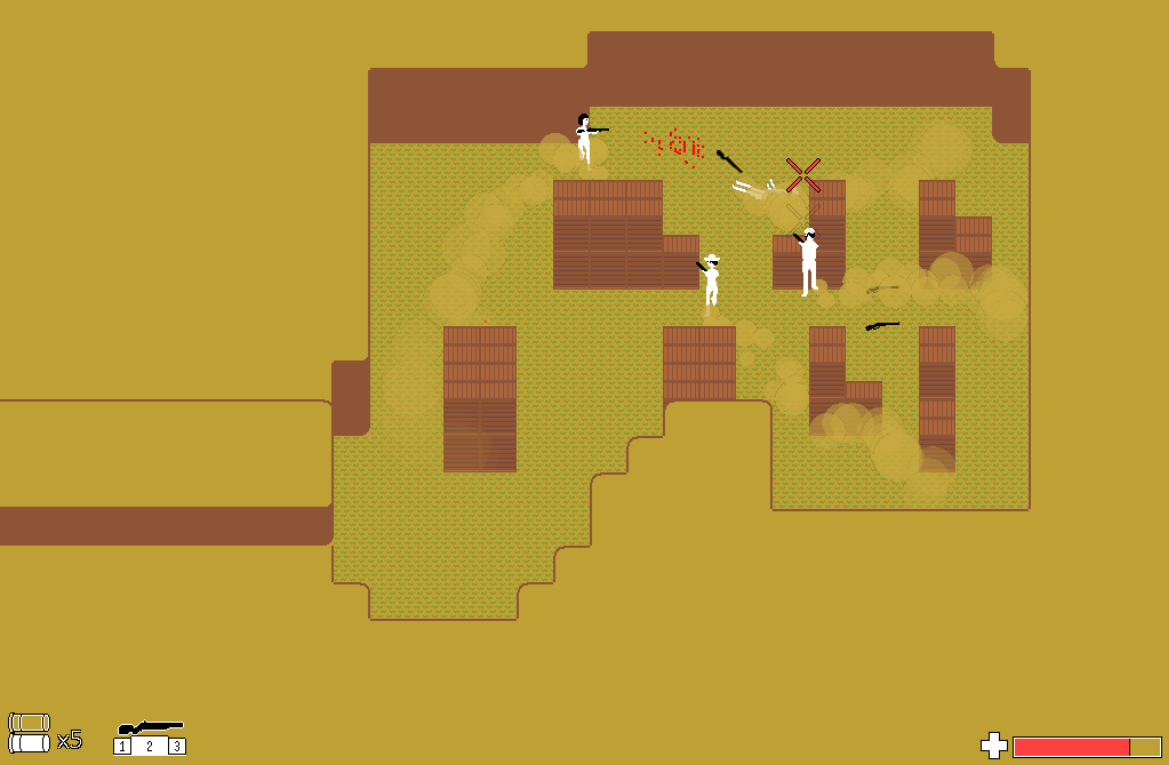
The Morphine Western Revenge
I completed the game in December of 2016, and it would go on to be one of the more popular things I've ever made, trying itself with Card Games vs Literary Characters for the number of browser plays (>900). I did some hand-wringing about how violent it was when it came out and a lot of hand-wringing about possible historical and cultural inaccuracy in the years to follow. I think I'm finally over it - the game is morally valid or whatever. I'm glad I made it – while it's a very different game from the beloved top-down shooter I had deleted back in 2009, I finally got to apply a lot of the lessons I learned from that game, especially regarding enemy AI. And while I've been making original music for games for a few years at this point, The Morphine Western Revenge's soundtrack is the first one that I'm unconditionally proud of.

Screenshot of Monsterpunk, formerly Toilets Meat and Drugs, from February of 2016, the last time I touched it before switching to The Morphine Western Revenge
While all of this was happening, I was still working on the post-jam version of Toilets Meat & Drugs, renamed to Monsterpunk in 2015, nearly 3 years after releasing the original game. It was still perpetual development hell: I continued to make big changes and add more content, continued to be dissatisfied, and continued to insist on my blog that the game was almost done. Spending 9 months on Morphine Western Revenge was a big blow to any momentum I had on Monsterpunk, but I wasn't done with it yet.

Do you want to know how overscoped Monsterpunk was? In September 2015, I had added a secret minigame with an original written, performed, and recorded song. The situation was dire. (In all fairness, Space Bird Watching IS my favorite part of Monsterpunk)
Back in March of 2016, just before starting work on Revenge I finally got a full-time job waiting tables. That December, I moved out of my mom's house and into an apartment with three strangers (two art students and a middle-aged photographer) in the Madison Park neighborhood in Baltimore, within walking distance of Station North, the city's arts district. Little did I know that the following years would be some of the most joyous in my creative career.