2003-2012/2012-2016/2016-2020/2020-2026

The Late Baltimore Years (2016-2018)
Glorious Trainwrecks and Baltimore Game Collective
Gewgawlicious, The Giant Robot Blues, and Monster Truck Power Fantasy

My bedroom in downtown Baltimore. This desk is where I'd make a handful of games for Glorious Trainwrecks, and where I'd keep throwing myself at Monsterpunk.

In my neighborhood, there was this park with these brick domes. I miss them.
Every year, Baltimore hosts Artscape, which advertised itself as the nation's largest free arts festival. It's a massive, multi-neighborhood, multi-day event with live music (usually with a few high-profile bands or artists), vendors, and performances. And inside a University of Baltimore building was Gamescape, the video game exhibition.
I applied to showcase a small collection of games in 2016 and got waitlisted. Strangely enough, when I went to the festival, I found an empty table with my name on it. The organizers claimed an error was made. Evidently. I'd try again next year.

There was literally a table with my name on it. Just let me show my games!
Ever since 2015, I'd been going to a bar and performance venue in Station North called the Windup Space. Sometimes I'd go to concerts, but I most often go to the regularly occurring tabletop game meetup, Brews and Board Games.
One of the organizers for B+BG (and I believe he was the founder) was a kind fellow named Stephen Thomas. We played some games together, and he'd prototype board games of his own design at the event. If people won games at the event, they'd be eligible for prizes of some sort (I think – my memory is hazy here, and the details in this story don't matter). Stephen had set up, on a laptop, a tiny video game that you'd play to determine whether you won a prize. I shared with him that I, too, made video games, and a friendship was forged, despite a nearly 20-year age difference.
It turns out that Stephen (aka let-off-studios) was affiliated with Glorious Trainwrecks, a not-insignificant online game developer community established in 2007 that promoted unpolished games with an anything-goes approach, especially ones that use stock or stolen assets. I was already familiar with Glorious Trainwrecks, but hadn't interacted much with its community yet. Stephen ran its Sekret Santa game jam from 2015-2019 in which every participant posted a list of what they wanted to see in a game, was assigned a gift recipient, and then had to make that game in a month. Stephen invited me to the jam, and I was eager to join. The punk-ish aesthetic tendencies of Glorious Trainwrecks appealed a lot to me, even if the games I made were still perhaps more polished than the average Trainwreck (to my detriment).

Gewgawlicious
Games weren't due until after the New Year, so in January of 2017, I released my first Sekret Santa trainwreck: Gewgawlicious, a short, comedic sandbox game for Marek Kapolka who asked for "little playground full of gewgaws that you can doink around and they'll buzz and sputz and interact with each other." In 2018, I'd make Monstertruck Power Fantasy for Stranger, an arcade game set to the length of an original song about a monster truck that was evocatively described by my recipient as "riding higher than the birds themselves," among other things. In 2019, I'd make American Wallrunner for mbtzl, who asked for a game with "wall running," "60s/Cold War aesthetic," and "lots of stats and meters for nonsensical stuff that you don't know the purpose of." It's all there. (I'd make a few more Trainwrecks into the pandemic, but we'll get to those later).

Monster Truck Power Fantasy
Monster Truck Power Fantasy really took off for some reason - it was downloaded over 600 times from Game Jolt that year, with the total download count across itch and GameJolt today resting at over 800, making it my second most downloaded game of all time.

American Wallrunner
More than any other game jam, the Glorious Trainwrecks Sekret Santa jams pushed me out of my comfort zone to make games I would never have thought I wanted to make. I don't like sandbox games, trucks, or parkour, but making games that incorporated these elements and making them my own through narrative framing, humor, and songwriting was delightful. And it was always exciting to share a game with someone who got exactly what they asked for. My favorite gifts I recieved were destroy yr boss the card game by fotocopiadora from the 2018-19 jam, and HVY MTL BLD LST 2512 by atuun from the 2021-22 jam. I loved these games - thank you both!
In April of 2017, I resumed work on Monsterpunk after a long break from it to make The Morphine Western Revenge. The same issues as before had plagued its development – I continued to remake environments and dialogue and systems and artwork, and I continued to add new areas. I felt like I needed to justify the time spent on it with an appropriately polished and scaled project, which trapped me in the trenches with it indefinitely.

Monsterpunk, April 2017
As I was floundering with Monsterpunk, I had met with Stephen outside of Brews and Board Games to discuss a game collaboration – some sort of arcade game inspired by the Marvel villain Galactus where you would consume planets? I don't remember, because at the end of our conversation, I made a proposition of our own – to apply for a shared Artscape table together. I may have gotten waitlisted the previous year, but perhaps if we combined our powers, we'd have a better chance...
As fate would have it, we forwent the collab game project altogether and went all in on exhibiting our game collection, titled "Underground Arcade," under the moniker "Baltimore Game Collective." Stephen printed zines with hobbyist game making resources, brought a dry erase board for tracking high scores for the event, and bought wonderfully tacky birthday balloons for decoration. I make a launcher program for the games and some punk cardboard & marker signage, and a shoebox full of prizes for people who placed themselves on the high score table. The prizes themselves were mostly trading cards I didn't want, but mixed among them were disks with our games on them (some people's laptops still had disk drives back then!)

One of Stephen's game-making zines!
We each contributed 4 games apiece: I contributed Gewgawlicious, The Morphine Western Revenge, Bloodjak, and Digital Toilet World, and Stephen contributed Astro-Path, Fungilluminati, Mutant Highway, and Swim Rush: Faster than Everything ft. Michael Phelps. Fungilluminati is one of my favorites of Stephen's games – it was an arcade platformer where you played as a mushroom and a talking piece of shit narrated everything that happened. This would also turn out to be the only event where we'd showcase Swim Rush, a joke game that asked the very important question: "can you feel the Swim Rush?" Later, when we applied for MAGFest, the event organizers asked us to remove the game for using a copyrighted photo of Michael Phelps in the intro screen, leading us to err on the side of caution and remove it from Underground Arcade for all events afterward.

The first version of the Underground Arcade launcher
This was also the only all-ages event where I'd showcase The Morphine Western Revenge. I naively thought that the posted content warnings in the launcher program would lead to festival goers choosing age-appropriate games. I was wrong. Stephen and I laughed our asses off as we watched a nine-year old play through the game with a stone-cold facial expression as he shot down enemies with cruel efficiency and repeatedly shot up heroin. We were lucky that we got it past the festival committee. I would not bring the game to family-friendly festivals and conventions ever again.
The original 2017 Artscape/Gamescape demo reel!
Overall, the event was a huge success. We were an anomalous presence at these sorts of events – most of the people with tables were fledgling indie studios or college students trying to become fledgling indie studios. Even among the solo devs who tabled, we set ourselves apart with our irreverent energy, distributable zines and game disks, and active high score competition. Nobody else at any event we attended ever had a competition – I thought it was low-hanging fruit if you were showing anything score-based!

Our first Artscape table. "Good luck!"
Organizers for other events in the area talked to us and invited us to apply, and so we did. We were now integrated into the Mid-Atlantic game dev festival circuit!
During our first Artscape, and during this Artscape only, we offered to make games for the winners of the high score competitions – Stephen would make games for the top score earners for Mutant Highway and Astro-Path, while I'd make one for the top score earner for Bloodjak. My recipient wanted a humorous game about a pilot escaping from the cockpit of a mecha, and so between August and December of 2017, I made a magical realist sci-fi Twine game with the prompt, titled The Giant Robot Blues. I hope the recipient enjoyed it. I may have put too much of myself into the game – made it too political, too weird, too much having-a-female-protagonist-when-he-asked-for-a-guy. I think I could get away with that when making that sort of thing as a gift at Glorious Trainwrecks, but it's harder when I'm making a game for a total stranger plucked out of the general population. But I dunno; he seemed cool enough, maybe he loved it.

Giant Robot Blues thumbnail
2017 would also mark the first time a game of mine would be showcased outside of an event I was tabling at. Moshboy, the aforementioned figurehead of the trashgame movement, was curating an exhibit of trashgames for Bar SK in Melbourne, Australia from October to November, and asked for The Void Hero Blues to be part of it. While I personally didn't consider VHB to be a trashgame (it was an earnest, but imperfect attempt at making as good-looking a game as I could, unlike Digital Toilet World or my trainwrecks), I was still delighted to have made the cut.
At some point in 2017, emboldened from Artscape, Stephen and I set our sights on the biggest gaming event in the region, and applied for the indie showcase at MAGFest. Unfortunately, little did I know that Microsoft would roll out an update for Windows 10 that would cause Game Maker Studio games to display a black screen upon opening. The fix itself was easy - I think I just had to edit each game, change a screen refresh setting, and recompile it. However, I didn't catch the error until January of 2018, after the judges tried running Underground Arcade, found that my games wouldn't play, and left scathing feedback, dismissing my work as "broken" (I think this was before MAGFest went on hiatus due to a scandal and had its leadership replaced). I was not keen to apply to MAGFest again.
In April of 2018, we added Cecil Con to our event rotation, a lovely nerd convention at Cecil College, Maryland. We returned to Artscape in 2018, taking Morphine Western Revenge and Swim Rush from our rotation, and adding Monster Truck Power Fantasy, Stephen's dungeon crawler Diablow, and his arcade shooter Project A.S.I.S..

Stephen plays Mutant Highway at Cecil Con
In case you were wondering: Monsterpunk was still in development hell in 2018. By that point, I had redone the game's tutorial a second time and ripped out the game's foundation from under it, replacing the time-based progression system with a more fitting experience point based system. I also redid the entire in-game menu! The changes I found myself undertaking to make the game fun were becoming more intensive.

Monsterpunk, March 2018, now with an XP bar
In May or June of 2018, my partner, Lisa, who I'd been dating for about a year, had asked me to make her a game for her birthday in July – something with cute animal characters in it. She had played a few RPGs at that point – Pokemon, Persona 5, and maybe Stardew Valley by then – so I started to work on an RPG Maker game for the first time since middle school to ensure that the game was of a familiar genre. The animal characters – a turtle and an otter – were inspired by the two of us. Alex became Agnes, and Lisa became Lulu. At this point, I had enough information to start piecing together that I was possibly not cisgender, and had begun exploring my gender through the character of Agnes. I'd miss the July deadline, but we'll get to that later.
And while all of this was happening, I was also walking downtown with my bass guitar to the home of a man in Station North who hosted jam sessions in his crow's nest apartment twice a week. I was a regular, so I was playing and improvising music for hours and hours with other people on a weekly basis. By the summer of 2018, I had joined a band and was writing songs with them, playing two shows before leaving Baltimore. Over a year and a half, I had grown a lot as a musician, songwriter, and composer, and in the years to follow, I'd start writing my best game music.
In the summer of 2018, I left Baltimore to move in with Lisa in Philadelphia. It was a bittersweet departure. I wasn't quite ready to leave my bandmates, but I was still close enough to Baltimore that I could continue to work the festival circuit I was becoming acquainted with. The Windup Space, where I had met Stephen and began my indie showcasing journey, had finally closed down. It felt like one of many signs that it was time to move on.
The Early Philadelphia Years (2018-2019)
Philly Game Mechanics and Underground Arcade Collective
American Wallrunner, Danger Zone Friends, We Meet in the Dungeon, and Bloodjak II
By November of 2018, three months after it was due, I completed the original version of my birthday gift game to Lisa, titled Danger Zone Friends. Lisa thought that it was weird that my stand-in character was a girl, so among the many changes I made for the final version, I assigned Agnes a male gender at birth (for the record, when I actually came out the following year, Lisa rolled with it seamlessly). Agnes became John Smith Agnes, but preferred going by her last name because John Smith was a sucky name and she was unattached to her masculinity, for some reason. (I gave her the name John Smith because, when I was born, my older sister had just watched Pocahontas and wanted me to be named John Smith). The final version of DZF was released to the public in January of 2019, just after I released American Wallrunner for the Sekret Santa jam.

Danger Zone Friends
What was originally supposed to be just a birthday gift had turned out to be my greatest creative achievement yet. It was my longest game, with a playthrough taking between 2 and 4 hours, with my most ambitious soundtrack at the time (clocking in at around 18 minutes). It was also the first game for which I had done the foley work to fully record and edit all of my own sound effects (except for Gewgawlicious, whose sound effects were all made with my mouth, which doesn't count). People loved the writing, humor, encounter design, monsters, and soundtrack. I felt like I stumbled onto something special.
By this point, I think I had finally given up on any pretense of prioritizing "art games" over everything else. Unlike my blog posts about Bloodjak and The Morphine Western Revenge, my writings about Danger Zone Friends were free of hang-wringing about violence, gaminess, and artisitic validity. I don't know if DZF was the turning point, or if I had outgrown my shame and pretension earlier, but I was too proud of the game for my feelings towards it to be tempered by it having "narratively unnecessary" turn-based combat and leveling up. I think the overwhelming positive feedback I got for my games during festivals and conventions had finally rid me of the devil on my shoulder that was telling me that nothing I made was artistically or morally justified. Good riddance.
While DZF wouldn't hit its peak popularity until 2020, in February of 2019, it had gotten covered by Indie Games Plus, which was awesome.
At some point in 2019, I had touched Monsterpunk for what would be the final time during its original run of development. It was supposed to be my feature-length magnum opus, but by now, Danger Zone Friends had supplanted it as the undisputedly better-looking, -written, and -sounding multi-hour long game. Monsterpunk felt obsolete, so I finally abandoned it.

Monsterpunk. One of the final things I added to the game was this music-themed sidequest that, like everything else I was adding to it, was cool but unnecessary
As I was working on the final version of DZF, I was searching for work, and I had applied for a job at a small local indie studio. I didn't get the position, but its members were part of Philly Game Mechanics, the local game dev meetup, and encouraged me to attend meetings. So I did.
PGM had a lot of professionals and wannabe professionals who were trying to foster Philadelphia's very tiny games industry, but a good number of folks who embraced making games for games' sake inside and outside those circles were present and involved in leadership. It wasn't a perfect fit, but I made some nice connections with some good folks.
In November of 2018, Philly Game Mechanics was organizing a games showcase at local media studio Colorspace Labs - the First Friday Arcade - and I signed up Baltimore Game Collective for the event. Between Artscape and Colorspace, Stephen had connected with game developer John D Moore, who had recently moved to Baltimore from Utah, and recommended him for the group. After a couple of email chains, we welcomed John aboard. It was immediately obvious that he was a perfect fit.

Our Colorspace Labs setup. More screens! More cardboard!
With now three of us in our ranks, we crammed 10 games onto the front page of our launcher program, with John's games Ungrateful Birds, Dr. Creepinscare's Pumpkin Patch Match, and my personal favorite, the pacifistic puzzle platformer Monster Hug joining the collection. First Friday Arcade would be one of my favorite events – it felt like a more art-focused than gamer-focused event, and it had positive, party vibes.

Colorspace Labs. Can YOU find Stephen and Alex in this photo? Photo credit: Colorspace Labs
In January of 2019, Philly Game Mechanics brought their arcade cabinet, The Phillytron, to MAGFest, and I had ported Bloodjak to the cabinet for the event. So at least one of my games made it to the convention, even if I never did. Getting to play the game on a real arcade cabinet when it was back in Philly was really cool.

Bloodjak: Phillytron Edition
Baltimore Game Collective returned to Cecil Con in April of 2019 for what would turn out to be the final one, as they would not return after the pandemic. Since I was no longer in Baltimore, after much deliberation, we renamed ourselves Underground Arcade Collective. I changed the UI of our launcher program from a static display of games to a scrolling menu, allowing us now to showcase as many games as we pleased. So, we went a little overboard and showcased 15 games: Stephen added Soul Eater and Star Kid to his offerings, John swapped out Creepinscare for Invasion Versus, his remake of 1983 action game Aaargh! Condor, and the absolutely legendary Koi Puncher MMXVIII, which I have very fond memories of playing the competitive multiplayer. As for me, I added a demo of Danger Zone Friends' first dungeon, which included a special Demo-Exclusive Boss at the end that could only be fought at in-person events.
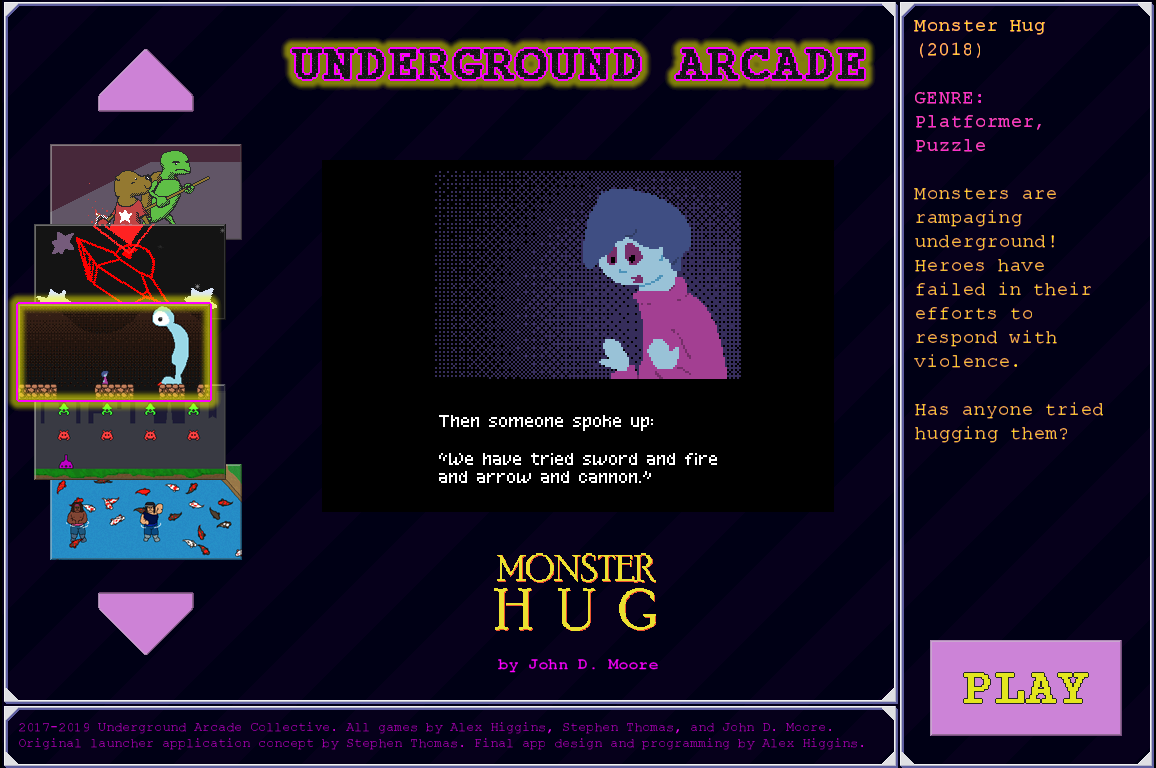
The Underground Arcade launcher: now with TOO MANY GAMES!
(Yes, since you asked, the Demo-Exclusive Boss did reappear in DZF's sequel, Jailbird Nocturne, as the most inside of inside jokes. Shoutout to the one person who fought the Demo-Exclusive Boss at Cecil Con or Artscape, kept up with my games for another six years, played Jailbird Nocturne, and then said, "hell yeah, it's this guy again!")

Danger Zone Friends' Demo-Exclusive Boss. It's like... the Mew of Danger Zone Friends.
There was much talk in our email chain about eating at the Denny's across from our hotel during the con. It turned out to be disappointing, if I recall.

I dug through my screenshot Twitter archive and found some good stories from the 2019 Cecil Con.
Philly Game Mechanics hosted a lot of game jams, and I participated in a couple in the Summer of 2019. In June, I made We Meet in the Dungeon, a very okay tabletop card game made for the "Try a New Jam" jam, which encouraged you to step outside your comfort zone - hence, I made something analog instead of digital.

We Meet in the Dungeon
But later that month, PGM began the Profit Jam, a 2 month game jam that encouraged participants to earn a profit, whatever that meant for them. I would turn out to be one of maybe two teams that took the direction literally. Enough people over the course of my life had encouraged me to sell my work, which I purposefully resisted because I understood that putting prices on my games would not make me much money and would only result in fewer people playing my work, but this was the push convinced me to give it a fair shot. I was now a skilled dev, and I had gotten a lot of attention on my work in the first half of the decade, so maybe I could pull it off.
I liked Bloodjak, I but thought I could make a more feature-filled version. After porting the game to the Phillytron the previous year and getting positive feedback from the community, it seemed like a good game to make a commercial sequel for. So I recruited an artist (Danielle Vuono), a composer (Dan Halma), and a sound designer (Alex Cole) to make Bloodjak II. I'm happy with how the game looks and sounds, but I want to give a special shoutout to other Alex, as he went beyond just supplying the assets I asked for and had conversations with me about audio implementation and cues that made the game play even better. Thank you!
Bloodjak II is probably the most polished game I've worked on – it's slick, and smooth, and runs at a high framerate, and has a complete options menu. For the first time, I was making a product first and a game second. I'm mostly happy with it – I think the new bosses and enemies I added to it make it a deeper experience than the original Bloodjak, even if the difficulty curve is off. For game that's meant to be played over and over, the intro is slow, and I don't think anyone has ever made it to boss #3. I only ever got there in testing by using god mode. Someone who's actually good at shmups will get there, surely, I thought to myself. I don't think I was right.

The never-legitimately encountered third boss. It's like... the Mew of Bloodjak II.
Marketing the game and divvying up the revenue, frankly, sucked. A team member asked me to draft up formal contracts for the revenue split, and while it was best practice (for good reason), it did feel like a lot of effort for something I expected to not sell particularly well. Making the revenue split difficult was the uneven distribution of labor across the team – I initially assumed we'd be doing an even 4-way split, but I didn't realize until weeks into development that each of my teammates was also working with other teams for the jam, meaning that I was the only one focusing on Bloodjak II for the entire duration, putting waaaay more labor into it. The ask I made at the end was that we'd split the money evenly four ways if the game made less than a certain amount, and I'd get a bigger split if the game managed to seriously take off. Everyone was a good sport about it, but the profit motive was souring what was otherwise a positive collaborative experience.
When I tried marketing Bloodjak II, I still hadn't fully realized how the indie games attention economy had changed over the past 6 years. I was still used to games like Waker and Digital Toilet World getting attention in the early 2010's just for existing. I had read a number of articles for triple-I Indie Devs about marketing strategies that, until then, weren't revelant to me (and never would be again), so I knew that marketing a game wouldn't be a cakewalk, but I naively though that creating a dedicated Twitter account for Bloodjak II and tweeting regularly to relevant hashtags would at least get me more attention that any game I had previously made would. After all, I was putting in more effort into promoting Bloodjak II than I had for anything else I made, so it should get me better results, right?
Of course not. But I can tell you what did happen: for that summer, I was the kind of indie dev I hated – the kind of soulless attention-seeking entrepreneur that spammed Tweets to #screenshotsaturday without giving anything to the community in return. And, of course, it got me no interest or engagement – especially by 2019, self-promotional slop was the ignorable background radiation of indie games Twitter.
Bloodjak II trailer
We sold the game for $4, put on sale for 50% off during a weekend in August, and then lowered the price to $3 for a couple of weeks in October when it was clear that sales were dead. We made about $66 bucks during that period, almost entirely from sales from my Facebook friends, which turned into $16 when split four ways.
Being contractually obligated to regularly, indefinitely, check to pay royalties for something, especially something that paid so little to me in return, was wearing me down. It was also disappointing to see so few people playing Bloodjak II and placing on its high score table (~13 scores in 2019) when the original game had over 60 scores posted for it, probably because the price tag was posing a barrier to entry, the primary reason I had never charged for my games before then. Seeing someone re-upload a free version of Bloodjak II to Gamejolt was further demoralizing. I reported it, but got no response.
I'd already floated the possibility to the team of making the game freeware if it wasn't worth the effort of selling it, so for the sake of my sanity, ten weeks after releasing the game, and just two weeks after lowering the game's price to $3, I made Bloodjak II freeware. Getting paid by my Facebook friends for a product that I then gave to the world for free just months later felt like shit - like an accidental con - but I could finally move on.
While I was surprised at the depths to which marketing, selling, and paying out royalties for a game was depressing, it otherwise confirmed a lot of my preexisting convictions about commodifying art, especially in a space as notoriously unprofitable as indie games. I'm glad that I sold and marketed Bloodjak II if only for the reason that, whenever anybody tells me I should sell my games, a conversation I have often, I can point to it and say "never the fuck again!" If I were 5 or 10 years older, if I had been at the top of my craft a decade earlier, maybe I could have made it work. But making a living in indie games has always been a lottery, even if the best chance at doing it was at the turn of the 2010's.
As for Underground Arcade, 2019 was our becoming busiest year. Despite our humble origins showcasing only at Artscape in 2017, we had tabled at five events in 2019! After our final Cecil Con in April, we were gearing up for denser summer and fall seasons. If felt like we were on an upward trajectory, with 3 members instead of 2, getting more eyes on our work each year, our creative output only improving. Little did we know that 2020 would have other plans for us...
In July of 2019, the three of us returned to Artscape. I had a WIP build of Bloodjak II added to the roster (the feedback was valuable!), and John had added copies of his self-published book to the prize box.

Our Artscape 2019 table. Terrible photo, but it's the best I've got. "have a GOOD birthday!"
In our coziest but most sparsely attended event, we showcased games at Charm City Meadworks in Baltimore in August. Since we were at a more adult-tailored event, John swapped out Ungrateful Birds for the darkly comedic visual novel Scales of Love, which (gasp) had swears in it.
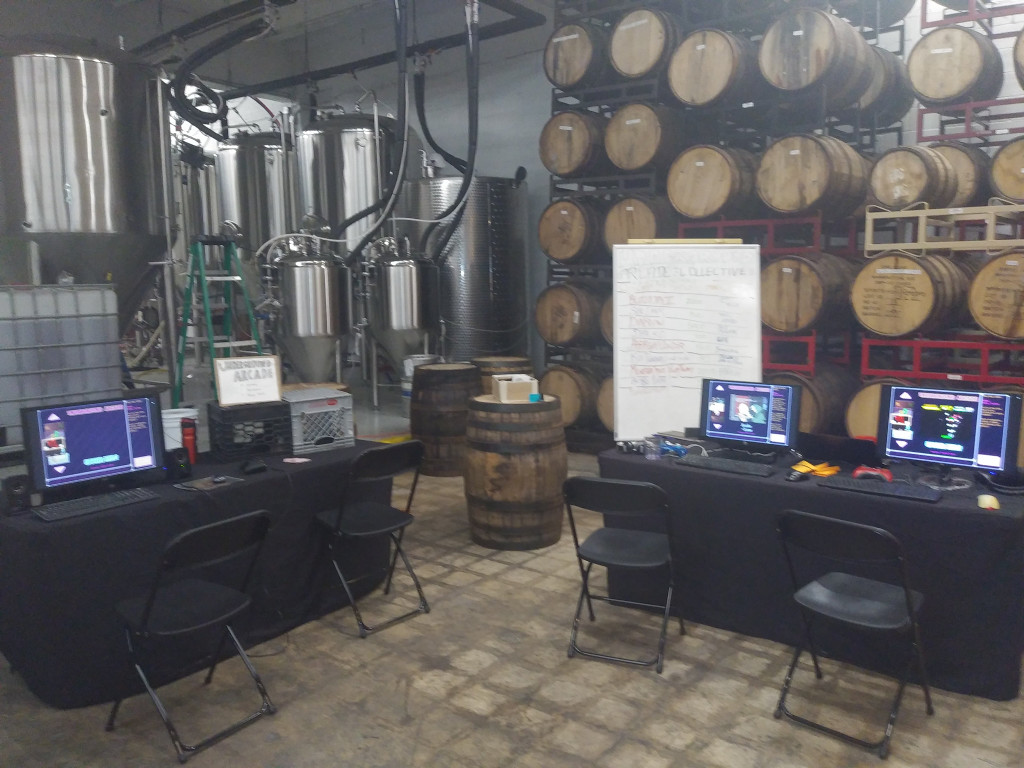
Underground Arcade at Charm City Meadworks!
In October, Stephen and I went to Comic Con for Kids in Oaks, PA, which turned out to be our least favorite event. Oaks is a suburban hellscape, and the convention center was pretty drab. Despite having a similar child-to-adult ratio as Artscape and us featuring the same sorts of games, the parents at Comic Con for Kids were weirdly reluctant to engage with our table. There was also some really cringe lightsaber battle choreography happening all day on the nearby stage, and I'm not saying it was cringe because it was lightsaber battle choreography, I'm saying it because it was really bad lightsaber battle choreography. It was a long few days. Stephen made some really cool shrinky dinks of our game characters though, while swapping his (never released!) arcade game Arbejeetyet? into our rotation.

Just some of the shrinky dinks that Stephen made: Agnes and Lulu from Danger Zone Friends, the robots from Gewgawlicious, and the player characters from John D Moore's Explobers
John and I made to to Colorspace Labs as Underground Arcade one final time in November. It wonderful.

The final Underground Arcade Collective event. Photo credit: John D Moore
Earlier that year, we had applied to MAGFest again, and got waitlisted. We then got moved off the waitlist only a week prior to the festival in January of 2020. We didn't have the availability to man a table for all four days, and it was too late to get an affordable hotel room, so we had to decline.
John made our final demo reel for our MAGFest application! They required 30 seconds of uninterrupted footage in the trailer, which is why the opening quarter of the reel is just Bloodjak II.
In March of 2020, we applied to Artscape. And then, in April, COVID-19 shut down the world. We wouldn't have the opportunity to showcase our work again until late 2021, but by then, the local festival and convention circuit had been completely upended, and each of us had found ourselves on new life trajectories.
Underground Arcade Collective has been the highlight of my creative life. Seeing hundreds of people play my games and offer kind words in itself was wonderful – I think it was the turning point in my own self-evaluation as a game designer, and it helped me erode the shame about my craft that I'd held since high school. Every game I made was valuable, it turned out, no matter how game-y or unpolished it was. Being able to go on this adventure with Stephen and John was a privilege. I couldn't have asked for two more creative, compassionate, and brilliant people to have tabled with. Paging through our old emails as I did research for this post stirred up feelings.
Grad School, Transition, Pandemic (2019-2020)
Card Games vs Literary Characters, Borderworld Hole, and Clark Stanley's Van Racer
The fall of 2019 saw two other big changes for me. The first was that I had begun a PhD in political science at Temple University. Making games while juggling a doctorate was a challenge, and while the program would mentally destroy me in four years time, I was functioning pretty well during the first couple of years.
The second change was, that after over a year of wrestling with the question, I finally admitted to myself that I was trans, just a week before starting grad school ("not NOW!" I thought to myself, "This is the worst timing!"). I came out to Lisa and my immediate family shortly afterward, but it'd be a year before I was out full-time. As much as it did for anyone, 2020 would mark a stark dividing line between two eras in my adult life: my pre-pandemic, pre-grad school, pre-transition life, mostly in Baltimore, from ages 22-26, and the post-pandemic, post-grad school, post-transition life in Phildalphia from 27 onward.
Life changes didn't stop me from participating in the Sekret Santa jam on an annual basis. In 2019, TheCakeFlavor asked a game with "cards, snowball, celebration, public domain characters, HDMI cable, cough ability," and "ideology." Ever since fotocopiadora had made a single player trading card game for me, I wanted to try that feat myself. Somehow, I pulled it off, and made Card Games vs Literary Characters at the End of the World – a single player TCG campaign with 94 cards and 8 opponents.

Card Games vs Literary Characters at the End of the World
Despite the rough presentation, it's become one of the most well-regarded games I've made. On itch, it is tied with The Morphine Western Revenge as my most popular browser game. The AI has a few critically bad habits, but I'm otherwise proud of how competent it is. The core rules are some of the best I've come up with for a tabletop game, the characters on the cards are fun - Tall Kick Woman is everone's favorite! - but the contrast with the melodramatic and somber tone of the story gives the game some emotional substance. I think there are few games I revisit as often as Card Games – the randomization inherent with the booster packs adds a lot of replayability to the campaign. It has the randomness and brevity of a roguelike, but instead of the shallow carrot-and-stick permadeath mechanics, it moves forward linearly and gives the player closure!
I'd update Card Games multiple times over the course of 2020, adding quality of life improvements in January and February and making final tweaks to the rules and cards in August after more rigorous digital and paper playtesting.
In May of 2020, after the lockdown started, I played around with the Trenchbroom level editor and made a Quake level titled "Borderworld Hole." I don't have anything deep to say about it, I just really like BSP level editing.

Borderworld Hole
In July, Stephen hosted the Grid Grind Jam, which I think would be the final Glorious Trainwrecks jam he'd organize. The community created lists of 6 personalities, 6 places, and 6 things from which we'd pick to make a game. When we were making suggestions for the lists, I'd had a literal dream about making a 2.5d racing game like Super Mario Kart, but with minivans. I wanted to make the game a reality, so I added "van" to the list of things. After the lists were complete, I chose "garden" for my place and snake oil salesman "Clark Stanley" for my personality, and I created Clark Stanley's Van Racer, a racing game with minivans that go over 240 MPH and a picture of Clark Stanley in the corner of the UI. Lisa's sister Claire made the music.

Clark Stanley's Van Racer
Clark Stanley wasn't my first time making a 3D game in GameMaker (always ill-advised), but it was my most technically ambitious. GameMaker: Studio has no built-in 3D model importer, so I had to convert 3D van models to code, render all 16 of them to the screen, and then render an entire racetrack that was bigger than any other 3D space I had made in GameMaker. I had to use every tool at my disposal to get the game to maintain a decent framerate – things that most modern 3D engines do automatically like hidden face culling, camera culling, and texture minimapping. Getting the splitscreen multiplayer to work without making the game chug was a technical feat – I had to cut down the draw distance and remove all the AI minivans. I put out the game in August.
By that summer, we were months into the COVID-19 pandemic lockdown, and my entire creative world was upended. Artscape was canceled, I was no longer attending Philly Game Mechanics, and the future of Underground Arcade Collective was uncertain. Taking and teaching classes virtually during the pandemic was depressing, and I was transitioning in secret, popping estrogen tablets in the safety of my apartment with minimal public exposure, preparing myself to come out full time before returning to campus in the fall (after an obviously foreseeable disasterous first week, admin would switch everyone back to virtual classes). That summer, however, would present me with an unexpected lucky break – my last one for years.