2003-2012/2012-2016/2016-2020/2020-2026
Introduction
On some date in 2006, I posted Earth 2500 to the Silent Walk forums, making it the first game I released to the public. That means that this year is my twentieth anniversary of putting games on the internet, and my twenty-third of making games more broadly.
To celebrate, here's a comprehensive personal history of me as a game developer: a retrospective of everything I've made until now and what it was like to make games during those decades, placing them in the broader historical context of the rapidly evolving indie game scene. The circumstances of making and sharing games online has changed a lot since the 2000's, and I'm starting to get old enough that I am no longer taking it for granted that history will be preserved. Any formerly DIY or underground cultural movement (like indie games) that breaks into the cultural mainstream is changed by that process and is mostly remembered by history in altered state, and any that doesn't break into the cultural mainstream is never remembered to begin with.
The original reason I wrote this is that I also didn't know what else the hell I was supposed to write to commemorate this occasion. My most self-indulgent blog posts are my most popular ones anyway, so it's a win-win for both of us. I'm just giving the people what they want. But now that I've written my whole story out, I think it's a good story. My creative life's had some drama and ambition and glory and roughness and joy.
This effort took a surprising amount of research, both into my personal life and into freeware indie game history. I read my undergraduate thesis on indie games and gender I haven't read in 10 years, played games of mine I haven't played in 20, went through every page of a wiki of a forum I once belonged to, read 8 years worth of posts from my old blog (restoring some posts I took down along the way), dug up email chains, and double-checked a lot of dates. While my personal work was influenced by indie games at large, I underestimated how tightly entwined the games I made were with broader indie trends until I compared the timelines.
Pre-history (2003-2006)
Elementary School, Middle School, and Game Maker 6
Alien Bombers, Blasterman 1-4, Blastership 1 & 2, Gameworld, Apocolypse, Nomkan Wars, lost shooter #1, etc.
The year was 2005. The most popular freeware games were made in Macromedia Flash and hosted on Flash Portal websites. Downloadable freeware executables were less popular (although I had just learned that indie game hosting site GameJolt has been around since 2003? Wild). Archetypal indie game Cave Story and the seminal Yume Nikki were both released a year prior, not that I would have known. Generalized indie game forum TIGSource was founded this year, not that I would have known. I was a kid. Despite Flash's dominance, accessible tools for creating standalone executable games were out there and would lay some of the groundwork for the coming indie game boom.
Throughout elementary school, I dabbled in game design in the ways that I could. I made fake strategy guides for Pokemon ripoffs that didn't exist, I made "levels" in Lego Creator, and I made choose your own adventure stories in Microsoft Word using hyperlinks. I had technically made my first video game as part of a summer camp program back in 2003: a little game programmed in HTML I titled "Alien Bombers" where a target would teleport around the screen and you'd click on it to score points. I completely forgot about Alien Bombers until after I finished writing my first drafts of these blog posts, so forget about it, just as I had, and return to 2005, where the story really begins.

I can't believe that my first game was Alien Bombers in 2003, and not Blasterman in 2005, as I've believed for most of my adult life! Ah, woops, I've been making games for 23 years, apparently! Nice pixel art for a 10 year old.
My family had one desktop computer that we kept smack in the middle of the house, in our dining room. I don't remember what exactly lead me to find and download Game Maker 6, but I did. I was in middle school, and I was hooked. I had already been making digital art in MS Paint and Photoshop Elements, so transitioning to making game graphics was seamless. Game Maker has drag-and-drop based visual programming that made it accessible to a younger kid, but it also used its own programming language (GML) that was powerful and versatile enough for me to grow with the program. I began with dragging and dropping game logic across the screen, but I'd teach myself to write GML a couple of years later.
Audio was still witchcraft to me, so I used public domain sounds and questionably legal music – a lot of it was Star Fox 64 music that I stole from another Game Maker project, not knowing the original source, and a lot of it was MIDI remixes of tracks from Megaman Battle Network.
I made do with the trial version of the program – I didn't have any use for the advanced features yet, and I didn't mind the splash screen that displayed on start-up. The full version of Game Maker back then only cost $15 – incredibly cheap for such a fully-featured game engine, even back then – but asking my parents to pay that much money felt like a huge ask.
I didn't know how to host downloadable executables on the internet, but I had a couple of friends in middle school who also had the trial version of Game Maker, and so I'd send them the editable files. Those emails would end up being the way most of these games got preserved.

Blastership 2, one of many games I made as a child I'm not going into much detail about here.
I created at least 12 complete games during this time. Early on I made a couple of barebones shmups, and a racing game with terrible controls, but the very first game I made (that wasn't just the Game Maker tutorial), was Blasterman, a top down shooter game where you play as the eponymous protagonist, a man in a gray spacesuit with a laser gun, who goes from level to level shooting men in red spacesuits and the occasional boss. After making Blasterman the first, I'd proceed to make three more games in the series, with each installment introducing new enemies and environments.
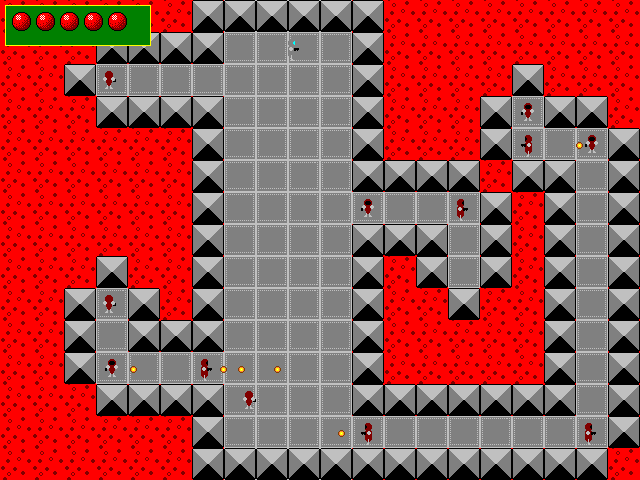
Blasterman 3: Blade Battle
I still like the Blasterman series. Some of the levels are clever, and some of the bosses are cool-looking, even if they weren't always threatening. By the third entry I started to do some honest-to-goodness environmental storytelling. Good job, 12-year old me.
However, the game that most surprised me when I did my research for this blog post was an unfinished action platformer where the player would explore levels themed around my previous games, titled Gameworld. There were a few things that delighted me about it on my very first replay 20 years later – the opening cutscene was cute, the level design was surprisingly varied – but what made it so fascinating was with how poorly I programmed the player character controls and physics, and how I seemed to have designed the game around it.

For someone who grew up to not like precise platforming, kid me sure did make some evil levels for Gameworld.
Let me enumerate the way in which this game plays like jank (and is all the better for it):
1) If you move sideways and then hit the jump button, you do a normal running jump like you do in any other platformer. However, if you jump first and then move to the side, it cancels any upward momentum you have, causing you to hurtle downward. This makes precise jumps tastefully difficult.
2) If you press against a wall while in mid-air, or press up against a ceiling, you will cease falling for as long as you hold the button. This often just delays the inevitable descent because you will fall as soon as you let go, but by ceiling-hugging, you can position the character in some useful places for shooting down enemies.
3) I didn't yet know how to set consistent, simple hitboxes for characters, so instead of being a rectangle, as is standard, the player's hitbox literally matches their sprite. Because the player character's chin juts out, this means that you can jump, grab a ledge with your chin, and then jump again up onto a surface. At some point, I seem to have started designing levels with this bug in mind – some jumps are impossible without chin grabbing.
I only made two themed stages for it. Level 2 was based on the aforementioned racing game (whenever you shot a car, it would make this hilarious glass-breaking sound), but level 1 was based on "Space Ball," the game I made from Game Maker's official tutorial, and, accordingly, used a smorgasborg of default GM assets – you'd have to shoot and avoid floating soccer balls, flames, and hamburgers. It was incredible.

Sometime after that, I made Apocolypse (tragically misspelled), my epic top-down action game about a guy who somehow survived the explosion of the Earth (he is on a floating piece of rock at the start of the game and is running out of air). After escaping on his ship, he then crashes on some forest planet, has a fight with a random guy with two guns for no reason, repairs his ship, gets captured by a bigger ship, discovers that the crew of the big ship was actually GOO ALIENS, and then escapes, with two-gun guy, who is now your friend, to the Goo Alien planet to kill the big Goo Alien. Afterward, two-gun guy reveals that everything was a dream.
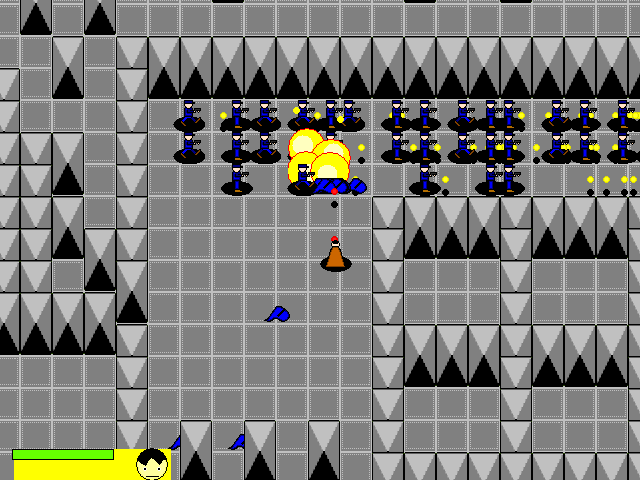
Chucking grenades at the enemy crew. This is before the Goo Alien reveal.
The protagonist spams grenades because I thought shooting bullets was cliché, but he just throws them in a perfectly straight line, like bullets, and he shoots as quickly as you can mash the button, and they don't actually have a blast radius. So he may as well be shooting bullets.
Sometime after (probably by 2006), I made some medieval action war game called Nomkan Wars inspired by the worldbuilding of Lord of the Rings and large-scale battles of Star Wars Battlefront. It had horrendous controls (you're stuck facing one direction and hit a button to attack every few seconds, and that's it), and you play as just one guy in the context of a massive battle of NPCS that you barely affect the outcome of. Not my best work, but there were some environmentalist and economic justice themes sprinkled in there, which was cute to see.

Nomkan Wars
The best game I made during this period was the first of my many Halo-ripoffs: a surprisingly ambitious side-scrolling action game about shooting aliens, complete with recharging shields, overheating weapons, and a fucking tank level. It was awesome. Unfortunately, this one was not preserved – I don't even remember the title. Of my lost games, it's the one I'm saddest about. It's the first game I made with original music, something I wouldn't attempt again until adulthood.
Sometime during this era, I also downloaded the trial version of RPG Maker XP, and did my best to make a complete game with original graphics in a month before the trial ran out. The game no longer exists, but I still have printouts of the party member art floating around. It'd be over a decade before my next RPG Maker project.

Found them! This was the first RPG party I designed, and this printout is all that's left from that game. You could equip them with all sorts of weapons, so I blacked them out in their artwork.
Revisiting everything from this time period, I was surprised by the unfettered creativity on display. I made a lot of games that unashamedly featured every cool idea I was excited about, regardless of plausibility or respectability. I wasn't yet ashamed of my hobby or interests, as I would by the end of the decade. There's an unabashed joy that in these games that I would lose and struggle to reclaim. While my game design itself was hit and miss, I was surprised how much intuition a child could have for what worked and what didn't - these games were more often fun to play than not.
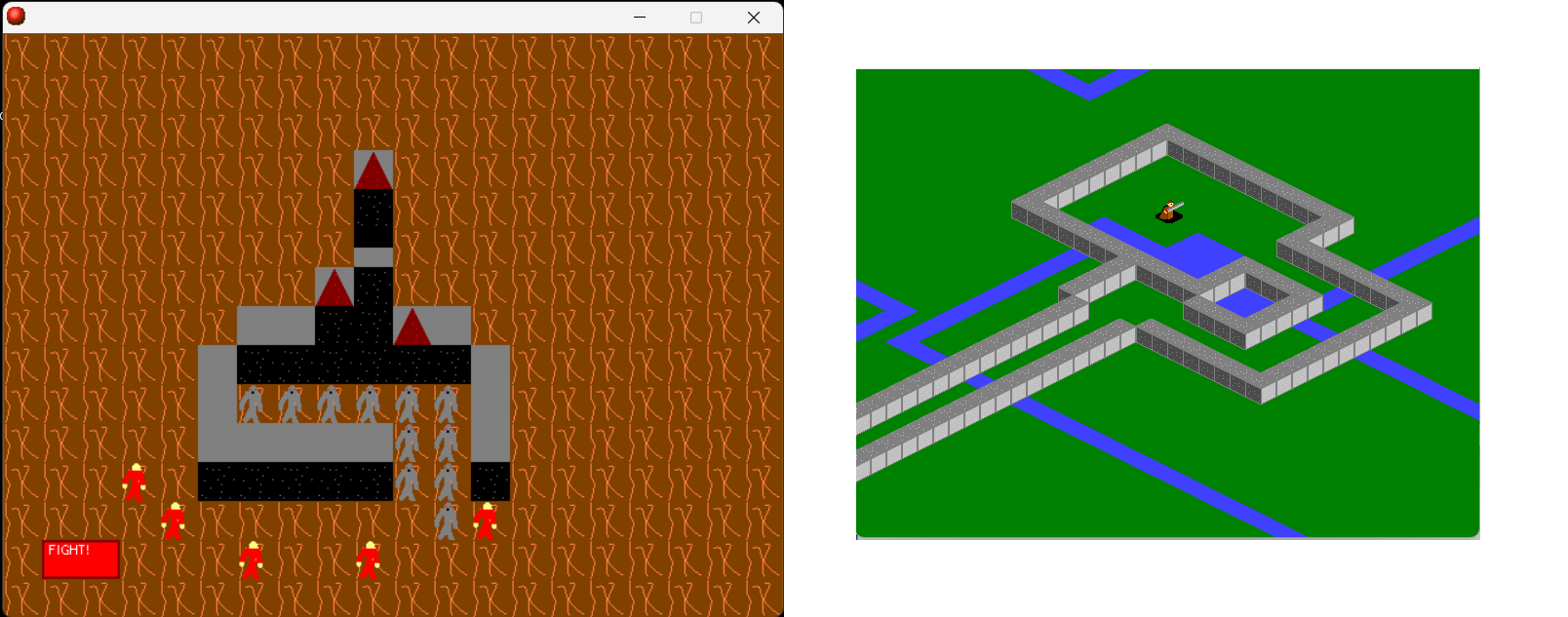
These are from a couple of WIPs that I didn't spend more than a week on

Oh, and I nearly forgot about this! Wamblin was an attempt at a turn-based fantasy RPG in Game Maker. I couldn't get it to run in GM:S, and I don't know where on my computer the original file is hiding now that I have GM8 reinstalled, but here's a screenshot of it from the level editor.
Silent Walk and its Forum (2006-2007)
Earth 2500 1 & 2, Night Cover, Halls of Kengratch Castle, and Black Star Nine
In the late 2000's, if you were a kid with no programming skills who wanted to make first person shooter games, you had two options. The first was FPSCreator, a polished, fully commercial game making tool by software company TheGameCreators, and the second was Silent Walk, a scrappier program designed independently by a hobbyist from Hungary (Silent Walk users believed there to be a rivalry between the two programs that FPSCreator users were probably totally unaware of).
Silent Walk had interesting limitations – it was designed, impressively, in Game Maker, which has limited 3D rendering capabilities – but I think its low-fi aesthetics (low poly counts and Quake-style frame-by-frame animation instead of bone-based animation) made it more accessible. It also had serious gameplay limitations. While you could create more complex level geometry with custom models and hitboxes, enemies could only meaningfully interact with the player on the "ground level," meaning that most games lacked any verticality and played more like Wolfenstein than Quake, even with the mouselook and jumping. The biggest limitations were with the weapons – all weapons in Silent Walk were hitscan semi-automatic guns that fired in a straight line and dealt 20 damage per shot. You could set the ammo capacity for the guns, change their accuracy (which affected the chance of the shot dealing damage, NOT the bullet trajectory), and whether or not the weapon had a scope… but that was it.
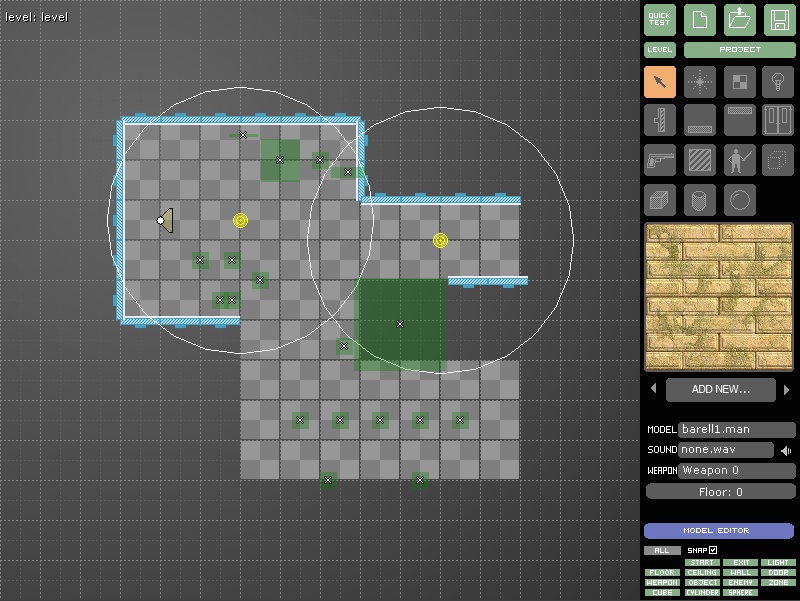
From Silent Walk Renaissance's website. The original SW1 editor looked very similar.
I think these sort of mechanical limitations forced me to focus on shooter fundamentals and get creative with the few knobs and levers at my disposal. To whatever extent I became a good action game designer, I think my Silent Walk years were where most of that learning happened.
During this era, game making communities were more often formed around specific pieces of software (Game Maker, RPG Maker, Flash) than anything else – I think TIGsource, as a general indie game hub, was one of the few major exceptions to this norm. While I had no connection to the broader Game Maker community at the time, the Silent Walk website funneled me directly to its own. The Silent Walk Forum (which I'm sad to discover have finally gone offline since the last time I checked) was mostly filled with middle-school aged boys (and at least two girls who hadn't figured who we were yet).
I was an early member of that community. I forget if I was the second or third person to post a complete game to the forum, but I know for certain that I was the first member to create a game with original art assets instead of the default zombies, gunmen, and interior wall textures that came with the program. That game was Earth 2500 – a Halo-inspired shooter with three short levels about single-handedly fighting aliens inside and outside your military base.
My original models didn't look great, mind you. The bigger aliens looked like giant turkeys. I didn't understand what UV mapping was or how it worked, so the textures on the models were randomly applied to its vertices and lead to the aliens and weapons looking abstract and sculptural. The game had dim lighting, so I was able to mask the ugliness, in any case.
Between that game and its sequel, Earth 2500: Stinger, I had gotten more of a handle on UV mapping and modeling techniques. My aliens looking more like aliens; my guns looked more like guns, and levels were more brightly lit, set in large, indoor and outdoor foggy environments. Since Silent Walk title screens didn't have save or load functionality, Stinger's first level was a hub level that with a level select, a tutorial option, and a "museum" with lore on the aliens. It was the largest Silent Walk game I would ever make, and I think it established me as one of the more prevalent creators in the community. It also was the first SW game I made that had stairs in it, something that wasn't explicitly built into the level editor (you could place walls, floors, and ceilings on a 2D single plane), but it was possible with clever placement of 3D models. The stairs didn't lead anywhere meaningful, mind you – they just lead to the top of a platform on a grassy plain – but I was just flexing.
I thiiiiink the next game I finished was Night Cover. Sometime between the first and second installment of Earth 2500, I played Metal Gear Solid, so now I was interested in stories about terrorists with nuclear weapons and advanced technology (I think I literally used MGS music for the soundtrack). You played as a secret agent infiltrating a nuclear weapons base. I think this game was my most ambitious – the stairs lead places, there were giant interior spaces constructed from custom models, there was a sniper alley, there were mines, there were office shootouts, you'd have to run from cover to cover between two buildings to avoid taking damage from a flying tank… I pushed the engine to its limits. This is the Silent Walk game I miss the most.
I made a couple more games after that – Halls of Kengratch Castle was a fantasy FPS where you blasted knights with magic, featuring nonlinear dungeons. There were also video cutscenes that I recorded in-engine, machinima style, that apparently crashed the game when other people tried to play it, so those ended up getting cut. Black Star Nine was my final Silent Walk game, a short, minimalist, horror set piece where you shoot zombies in a dark space ship with a shotgun and do little else - I must have been drawing inspiration from Half-Life 2, because horror games are not something I've ever been drawn to.
Sometime by 2007, Zoltan had started creating Silent Walk 2 – a more fully-featured but, frankly, buggier version of the program. While dozens of Silent Walk 1 games were released by the community from 2006-2009, I don't remember anyone ever releasing a Silent Walk 2 game. The nail in the coffin for SW2's continued development was when a bunch of people – including, allegedly, some forum members – had scammed Zoltan out of keys for Silent Walk 2. He was left with the bill for payment processing fees on refunded keys that the users got to keep, which was upsetting, so he announced a break from software development. The demise of SW2, paired with some trolling and hacking of the forums during its final active years, had spelled the end of the community.
This was still all before content hosting platforms like Youtube, Bandcamp, or itch became commonplace, and while you could link to games and screenshots on the forums, finding free and long-lasting services for actually hosting images and files was not trivial. All of my Silent Walk games were hosted on FileFront, which would go bankrupt just a year later. The site would later be reborn as GameFront, but most, if not all, of the user-hosted content on the site was unceremoniously deleted before then. This wouldn't have been an issue if my games were still on my computer… but I'm getting ahead of myself.
In 2009, forum member XTCgames apparently created a Wiki for Silent Walk, which I'm grateful for, because it's one of the few records we have left of this community and its activity. Thank you to whoever wrote the very kind tribute. (I did edit the pronouns).
I ended up leaving the forums, I'm guessing, sometime around 2008. I don't remember the exact reasons – part of it definitely was because of the bugginess of Silent Walk 2, but the wiki writers also mentioned that I left due to "personal reasons." Maybe it was because of forum drama, maybe it was because of my increasing shame about making games (we're getting to that part!), maybe it was because of both.
I'm pleased to see that, sometime after I left Silent Walk, Zoltan returned to making game dev tools, including an upgraded fork of the original Silent Walk called Silent Walk: Renaissance. It's still a little buggy (I played around with it and had to run a line of custom code to get gun damage to work correctly), but teenage me would have loved to make games in it.
The Silent Walk forums was the first place I found community among other game devs, the first place where I shared my work with strangers, and the first place where I'd make a long-term online friendship. It's funny to think of how such an all-encompassing online space would turn out to be such a short-lived blip in the grand scheme of history, but for a while, it was home.

At some point in 2018, I'd started making a Silent Walk Renaissance game for old time's sake (I dusted off my 3D modeling skills to make that assault rifle!), but I think there was a time and place for SW, and I was past it.
Shift + Delete Everything! (2007-2009)
High School and the YoYo Sandbox
Sledder, Rogue Gun, and lost shooter #2
I never stopped using Game Maker during the Silent Walk years, but it was around 2007 when my relationship with the tool and the greater indie dev community began to evolve. By now, I had discovered the Game Maker Games website (the archive of which can be found here), which was created in 2003 for Game Maker devs to host their work when Mark Overmars stopped hosting games on the official GM website. While folks have been sharing GM games online since 2000 (seminal GM game Seiklus and childhood fav Hovendall Tactics both came out in 2003), the most influential and popular games I played were made from 2006 onward. Of special historical import was Matt Aldridge's La La Land series in 2006, a groundbreaking example of a dark, subversive, dreamlike aesthetic that I have not seen replicated in earlier work, and Daniel Remar's Iji in 2008, an impressive full-length System Shock-inspired platformer with branching narrative dependent upon player behavior that, to this day, has set my standard for what an individually-produced freeware magnum opus could look like.
Also in 2008, Terry Cavanagh (better known later for VVVVV and Super Hexagon) and Catcus (better later for Hotline Miami) had collaborated on Xoldiers, in addition to making dozens of other freeware works separately. Greg Lobanov (better known for later for Wandersong) had put out a little action platformer called Assassin Blue that I played on repeat. By 2009, Amon26's dark, moody, horny, violent action platformer All of our Friends are Dead had wormed its way into my psyche, and starting with Opera Omnia (2009), I had discovered what would become a collection of hundreds of freeware games by the legendary Increpare.
2007 would also see the acquisition of Game Maker by YoYo Games, beginning its transformation from a relatively obscure hobbyist tool to a mainstream commercial solution for capital-I Indie game development. This came with the creation of the "YoYo Games Sandbox," and official corporate counterpart to Game Maker Games for hosting users' creations (archived here). For the first time ever, through the Sandbox, I had begun uploading my Game Maker games online for the general public.
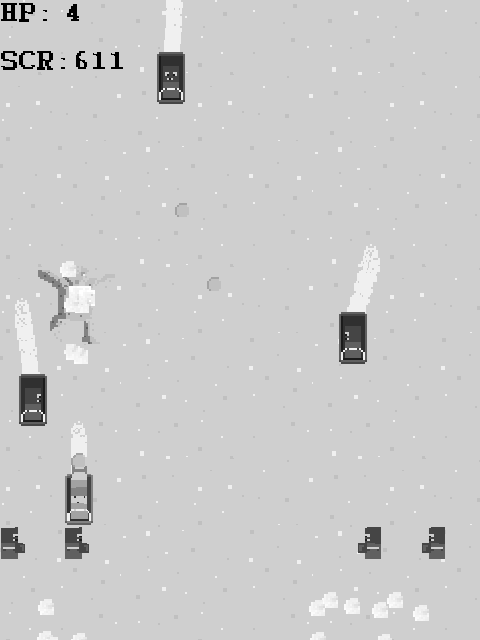
Sledder
Arcade game Sledder (2007) was the first of these games – YoYo was hosting a competition for winter-themed games, and Sledder was my entry. You ride downhill in a sled and score points for hitting enemies with snowballs. By this time, I had started to teach myself to write "real" code (i.e. GML) instead of dragging and dropping blocks, and I was generating my own sound effects with SFXR. My biggest project at this time, however, was Rogue Gun, a side-scrolling shooter inspired by Halo with limited weapon slots, recharging shields, equipment, and aggressive enemy AI. I released a WIP demo in 2008 to the Sandbox, but it would be the first of many overambitious, lengthy, unfinished Game Maker games.
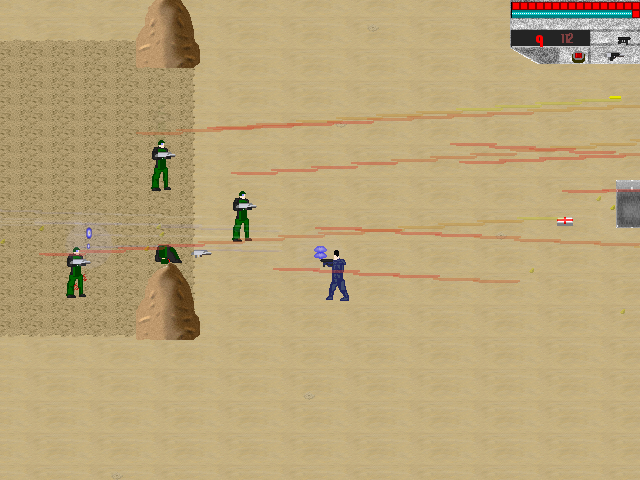
Rogue Gun
Sometime around then, I had outgrown Rogue Gun and developed a top-down shooter instead. It was the project where I finally felt like I "came of age" as a programmer – I was making a shooter game with hitscan projectiles and enemies with algorithmic pathfinding and reactive behavior. You could dash to avoid beautiful lines of turret fire, leaving after-images in your wake. Enemies would scurry and run if they saw rockets or grenades fall in front of them. Reader, the game was fun as hell. Unfortunately, my feelings about making games was changing.
By year three of my game development hobby, I had started getting some negative feedback from family members about it. Comments over the years would range from "you need to spend more time outside" to straight-up "I don't approve of this video game thing of yours, but...". Talking to one of them about it later, it was clear to my parents that, by 2007, something was going wrong with me – I was a disassociating, spacey, unusually depressed teenager, and they couldn't figure out the cause. By college, we would figure out half the puzzle, and I'd get an ADHD diagnosis. But the more pressing issue was that I was trans, but it was the late aughts, so the word "transgender" wasn't even in my vocabulary, and male puberty was hellish for a teenage girl. So, I escaped into computers because my embodied existence was becoming so unpleasant. All my parents saw was a correlation between me making things with computers and being miserable, so they blamed the computers. Maybe the moral panic around games in the 90's and 2000's had something to do with it, maybe not.
Things would eventually come to a head, but there's one last piece of context we need to cover before we get there…
As we entered the late 2000's, the modern canon of what were now explicitly called "indie games," and within that, the movement for "art games," began to develop. Jason Rohrer released overrated game poem Passage in 2007 (it makes me feel nothing!), and Johnathan Blow released overrated "artsy" puzzle-platformer Braid in 2008. (While I'm glad that popular opinion on Braid has soured over the past 15 years, it was frustrating to no end at the time when almost everyone hailed it as a revolutionary masterpiece. The true revolution was happening elsewhere, and Braid was a mediocre representation of it. I want everyone to know I hated Braid before it was cool.)
2008 also saw Gregory Weir's (I Fell in Love With) the Majesty of Colors, which I remember more fondly. I've already mentioned Cavanagh, Cactus, Increpare, and their work, but beyond being prominent Game Maker devs, they were also pushing the perceived envelope of what could be done artistically with the medium of video games using a variety of tools and game engines.
Johnathan Blow has always been a prick-ass and had taken the meaning of "video game" literally, and I remember him arguing that anything that didn't have win or loss condition wasn't a game, providing a rather narrow path for what qualified as an "art game." But on the other end of the spectrum was Tale of Tales, a small arthouse studio at the forefront of the "notgame" movement who I remember snagging an NPR headline with their 2009 Little Red Riding Hood riff The Path, an interactive art piece that involved a lot of walking and observing but little in the way of conventional gameplay or challenges. Their philosophy that the best way to advance "games" as an artistic medium was to eschew their game-iness: a perspective refreshingly opposed to Johnathan Blow's, but just as restrictive.
Given the shame I was internalizing around making and playing games, I ate up the "notgame" philosophy. This was the answer. I could still make games without actually making games. I could not make games. I could make… notgames.
("But if it's not a game, what is it?" someone would ask. "That question is inconvenient" was the answer. The consensus, thankfully, has since become that anything that you interact with as a video game is a video game, literal meaning of the word "game" being irrelevant. But year was 2009, not 2026, and I was not yet so enlightened.)
And so, between the disdain for games I internalized from my family and the criticism of games from Tale of Tales and "artgame" pioneers more broadly, I was not feeling charitable toward my craft as I'd been doing it.
Things came to a head in 2009 when one family member was vacuuming the car, neither of us was paying attention, and they almost hit me in the face with the hose. They blamed the incident on my lack of attention (and not theirs), and directly connected it to "all the time I was spending on the computer." When we got home, filled with shame, I went and shift-deleted every single game I made. Every. Single. One.
I REALLY WANT TO STRESS HERE that the family member and I have since talked about it, they apologized, I got closure, I forgive them, and we're good now! This happened a long time ago, and I hate to even bring up decades-old family drama in a public blog post, but it's impossible to tell my story without it.
As I mentioned in passing before, some of my games I was able to recover – anything I had sent as an email attachment or uploaded to the Game Maker Sandbox was retrievable. But everything else I made – a handful of early GM games, all of my Silent Walk games, and the top down shooter I had been working on - was lost. I miss them.

I don't have any screenshots of the original top-down shooter game, but sometime around 2010, I tried remaking it from scratch. I abandoned it shortly after making the arsenal.
Artgame Snob (2009)
Tale of Tales and GMG
Robot Horde at Wasteland Summer Retreat, How to Fly, and A Day by the River
So I spent a quick spell on Tale of Tales forum, and I remember two things from that time. The first I remember a rubbish thread that was orthodoxically hostile to boss battles in games (in all caps at the bottom, it said "KILL THE BOSS ROUND! KILL THE BOSS ROUND! KILL THE BOSS ROUND!), and, in hindsight, it felt strange to target this particular tradition in game design instead of critiquing violent game design more broadly, but I digress.
The second thing I remember was telling Tale of Tales co-found Michaël Samyn that his work had inspired to destroy everything I had made until that point, to which he said something along the lines of "if you're happier now, then good for you, glad I could help I guess, but I never wanted my work to push someone to do that." In hindsight, if someone told me that their work inspired them to do something self-destructive, yeah, I'd be a little weirded out too.
I was effectively forced to make one last "normie" game before going all-in on "notgames" for the rest of the year: in February and March of 2009, my mom enrolled me in weekend game dev classes as part of a short, month-long course. Everyone made a Flash game where invaders would travel across the screen, and you'd click on them to stop them and score points. Mine was called Robot Horde at Wasteland Summer Retreat! I remember being annoyed at having to make a score-based game, given my newfound disdain for not-notgames, and I think the flavor text on the menu was my attempt to compensate for it, to have a satirical element present to make it more than "just a game." I think the end result is that the menu screen is actually really cute! I think there's a cheekiness on display here that wasn't in my earlier work and wouldn't become emblematic of my future work for another 4 years.

Robot Horde at Wasteland Summer Retreat! "Oh, deary me!"
I'm not sure what inspired my mom to support me to take actual game dev classes - I don't know if either of my parents knew about the post-vacuum game deletion incident at the time, or what her specific feelings about me spending so much time with the computer were. But I had forgotten that there was much support mixed into the apprehension, and I'm grateful it was there. Hell, a big reason I got so into computers to begin with was because my dad involved me every time we upgraded the family machine, which was often because I needed something with beefier specs to keep up with improvements in game graphics. Feelings are complicated.
I'd go on to release two final games that year before entering a long creative dry spell. The first was How to Fly – my attempt at a high-art Jason Rohrer/Tale of Tales-inspired notgame game-poem. You'd play as a bird that flies across the screen, eating mosquitoes and getting bigger as you did. You'd see some strange events in the background representing death and societal ills (I think?) – a bird cage opens, a hunter shoots down a flock of birds in rapid succession, another flock of birds kill themselves trying to roost at the same tree, a guillotine falls. The sun sets, the screen turns red, the player turns into a mosquito and splatters on a truck's windshield. No matter what you do, your score at the end is 0. It was aspirationally metaphorical and gave the middle finger to a player who expected to earn points, be challenged, or have fun.
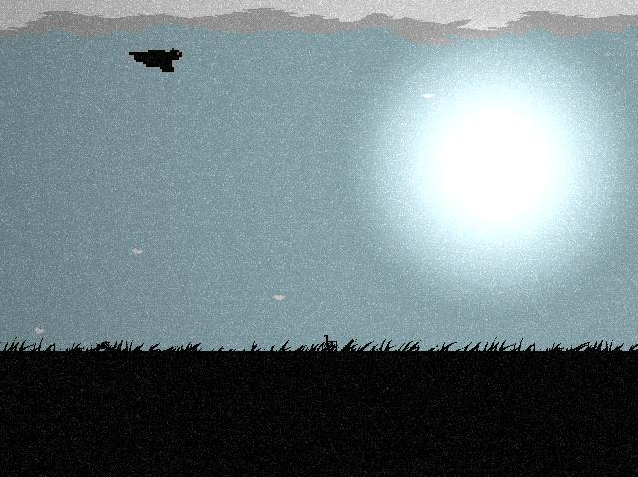
How to Fly
It was the first and last game I posted to Game Maker Games. I got a lot of critical comments saying that a "game needs to be, well, a game," and should have some sort of objective or challenge for the player. At the time, I was like, "well La La Land is well-regarded on this website, what gives?" Now with more distance, I realize that the sole interactive aspect of How to Fly was too subtle – if players don't realize they can eat bugs, then there isn't much substance to it, is there? And even if they did realize it… well, it still wasn't exactly indie cult classic caliber.
I am still proud of how the game looks – by this stage, I was starting to get good at pixel art, and I was playing around with blend modes and film grain effects.
The other game I made this year was A Day by the River, a game I made for a high school English class project. You play as a silhouette who encounters various people, can be excruciatingly nice or cruel to them. The nicer you are, the more saturated the screen becomes, and the audio switches to birds chirping. The crueler you are, the redder the screen becomes, and the more ominous the audio is. At the end of the game, you fall into the river, you suffer a heart attack, and if you've at least been pleasant to all the people you previously encountered, they'll all help save your life. If not, you die. I think I was unconsciously inspired by the extreme, unsubtle morality of Star Wars: Knights of the Old Republic, where falling to the dark side meant that you were killing random NPCs on the street for being mildly annoying.
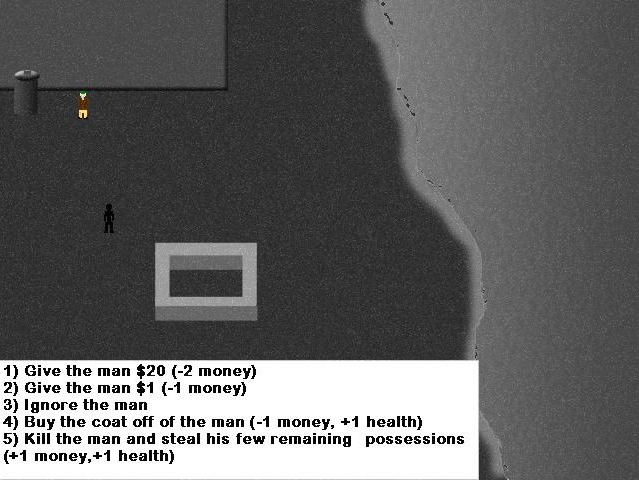
A Day by the River
I meant for my game to be a Very Serious piece of art. But on the day I presented it, my classmates had laughed. They weren't laughing at the game per se – they loved it - but the evil you could commit in the game was so cartoonish, and the consequences for it so cosmically absurd, that the whole game was a bit ridiculous. It's very heavy-handed.
While my commitment to "notgames" would slowly relax throughout my coming college years, my internalized hatred of game-y games would come off as pretension and snobiness about anything that was too fun, too much of a power fantasy, not enough of a metaphor. To my college friends, I apologize. I must have been insufferable at times.
The Dead Years (2010-2012)
Sonny the Red Wolf and Station to Station
I'm not sure what exactly happened during my late teen years. From 2010-2012, I failed to release a finished game and had no web presence. The lack of documentation makes it hard to confirm or remember what exactly went wrong and why.
Part of it, probably, was that I was trapped in the narrow design space of "games as art." The part of me that had created games joyfully, without ambition, was mostly asleep. I felt I had to make something with depth, not "mindless entertainment." Anything that too closely resembled a conventional video game was off the table, barring external pressure. This mindset made it hard to create prolifically or feel motivated to see anything to completion.
Part of it was that, at this point, I had likely played a number of full-length freeware indie masterworks (Cave Story, Iji, Exit Fate) that had distorted my idea of what a good, freeware, indie game looked like. If the indie game scene coalesced in the late 2000's, then the early 2010's saw it crack into gaming's mainstream. Porpentine was writing freeware game reviews for fucking Rock, Paper, Shotgun. Terry Cavanagh's Super Hexagon would get a cameo in a 2013 Adventure Time episode. Indie Game: The Movie came out in 2012 and would warp popular understanding of indie game culture and history with it. Minecraft, originally created by one guy, was in development from 2009-2011, but it was still playable in its pre-alpha state and was on its way to becoming the best-selling game of all time.
The way I identified with my work changed when what I used to think of uncritically as just "games" became "indie games" I identified with the indie game movement. I was now comparing myself to bigger, longer, better written games, and I felt I had to keep up.
So, I was attempting longer, more ambitious projects, but I was growing as a game developer at the same rate I had always been. This meant that I'd outgrow projects before seeing them through, finding myself unable to commit to something because I knew that if I started over I'd make something better.
By 2010, critically acclaimed indie games were still by and large free, short, unpolished works. Games like Braid were rarities. While not the first "triple-I" title, Supergiant Games' commercially released Bastion (2011) pushed the window on what it meant to be indie. To the best of my knowledge, every "indie" game until now was quite literally independently produced, i.e., self-published. Bastion, however, was originally published by Warner Brothers, and received some scrutiny for the partnership. If an indie game wasn't a game that was independently published, then what the hell did the label mean anymore? In the coming decade, "indie" games would enter a period a transition, where commercial games with higher production quality, often published by a third party on multiple platforms, would displace the scrappier freeware indie scene that preceded it. This transition would further lead me to place increasingly unrealistic expectations on myself for what I could produce in my free time as a solo hobbyist dev.
But this transition was still just beginning. In the meantime, the early 2010's saw what, from my prospective, was the last big wave of semi-famous freeware indie creators – what was once covered by the press as the "queer renaissance" in indie games, consisting mostly of trans women, some of whom were more closely affiliated with each other than others. I myself was mostly playing the games of Anna Anthropy, Porpentine, merritt k, Christine Love, and Mattie Brice. Digital: a Love Story (Love 2010), Lim (k 2012), Mainichi (Brice 2012), and Armada (Porpentine 2013) were once all deeply influential to me. Especially Armada - Porpentine was my favorite developer around this time.
While I would come to learn that not everyone (or anyone?) in the west coast trans indie scene specifically was a nice person (a lot of abuse allegations have floated around), my own Coming Out Journey ™ nonetheless began with their games. They were the first out non-celebrity trans people I knew of – the word "transgender" had entered my vocabulary at some point between 2009 and 2011, but until now, it was a strictly theoretical concept. Until this point, the only representations of trans people in media were pitiable punchlines and vomit-inducing caricatures. I'd occasionally hear the adults in my life laugh to each other about the transsexuals they'd encountered. For these reasons, my initial reaction when I learned that my new favorite indie games were made by transgender women was disappointment and disgust. But I still played their games, and they still spoke deeply to me, for reasons I would better understand nearly a decade later. I was jealous that these game developers got to be women, not understanding that the jealousy meant I was one too.
Beyond the queer scene, Twine, a free and highly accessible tool for making interactive fiction, came out in 2009, and became wildly popular after Anthropy endorsed the program in 2012. The "Twine revolution" introduced a noticeable shift to the freeware scene, introducing a lot of personal, political, weird, and artistic pieces of IF into the ecosystem.
Finally, a little game called Space Funeral by thecatamites would come out in 2010. This, paired with the English fan translation of OFF that would finally release in 2011, would blow open my perception of what an RPG Maker game could look like and what an RPG could be.
As far as my own work during this period, making interactive "notgame" art that actually interested me often meant making narrative adventure games. A 2D game of this sort was my first failed attempt at a longform, interactive story, but didn't make it far beyond development outside of character art and a handful of screens. It was, however, my first game to feature a female protagonist (one who, funnily enough, looked a little like me… interesting…) instead of the gunslinging dudes I had uncritically assumed must star in games by default.
My next aborted project was Station to Station, an overambitious 3D project with multiple characters and branching dialogue. This one lived longer before getting abandoned in 2011 – there's several neat areas and conversations, including a sequence on a moving train that I was particularly proud of. Replaying it now, I'm impressed by some of the environmental design, even if the writing doesn't quite keep up.


Station to Station. I really enjoyed the variety in environments on my replay - I couldn't just pick one screenshot!
During this time, I started giving myself the rare allowance to make a conventional, actually fun game again, something I hadn't voluntarily done in a couple of years. In 2010, while I was entering my senior year of high school, a kid in my neighborhood asked me to make a game for him about a red wolf named Sonny who would travel in a spaceship to defeat Dracula. I started making an action platformer titled In Which Sonny the Red Wolf Decides to Show Dracula Who's Boss, but he left the neighborhood before I could finish the game.
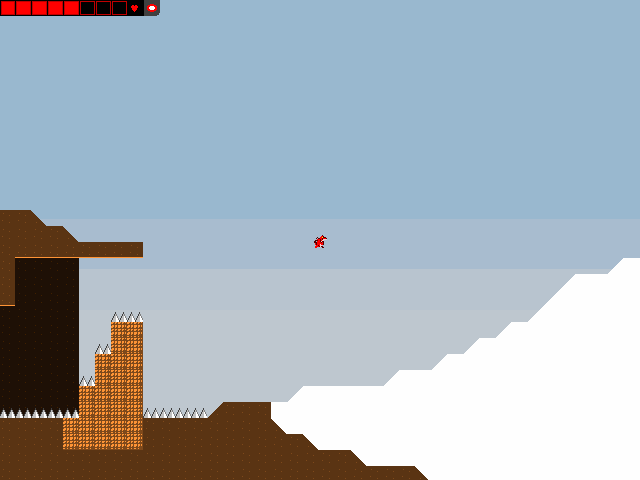
In Which Sonny the Red Wolf Decides to Show Dracula Who's Boss
At some point before my 20's, I tried making a retro arcade FPS that consisted a single sandbox level to be defended from eldritch aliens. I justified this one as a tone piece that captured the feeling of staving off an inevitable demise. I never finished it – maybe the premise was too depressing, maybe I realized that what I was making was, deep-down, just an action game that violated my artistic code. This wouldn't be the first time that the tension between art and entertainment would be present in a shooter game I've made.

One last WIP I forgot - Mechabirdy, who I was still friends with after leaving the Silent Walk forums, tried collaborating with me on a medieval action platformer inspired by Assassin Blue. She created a website and forum for us to migrate to for our post-SW game-making endeavors, and we were the only users. I thiiink the player art is mine and everything else is hers, and we both programmed aspects of it, but don't quote me on any of this. Anyway, we got about as far as this demo level. I love that "Time to Shine..." is the opening text for the level, I think that was her touch.
During my teen years, I had been slowly accumulating formal education in every aspect of game development. I was taking bass guitar lessons from a hippie who lived in an RV from 2009-2011. He was an excellent teacher, and he taught me enough music theory to write my own songs, a skill that I would start using for games a couple years later. The bass lessons would also lead me to ditch playing clarinet for band class, which opened a slot in my schedule during my senior year to finally take a school art class for the first time since fifth grade. Training in writing, art, and music composition had now all been acquired.
Before I knew it, two and a half years had passed, and I hadn't released a single new game. I still had another whole year to go before I would.
2003-2012/2012-2016/2016-2020/2020-2026